What happens when you roast coffee?
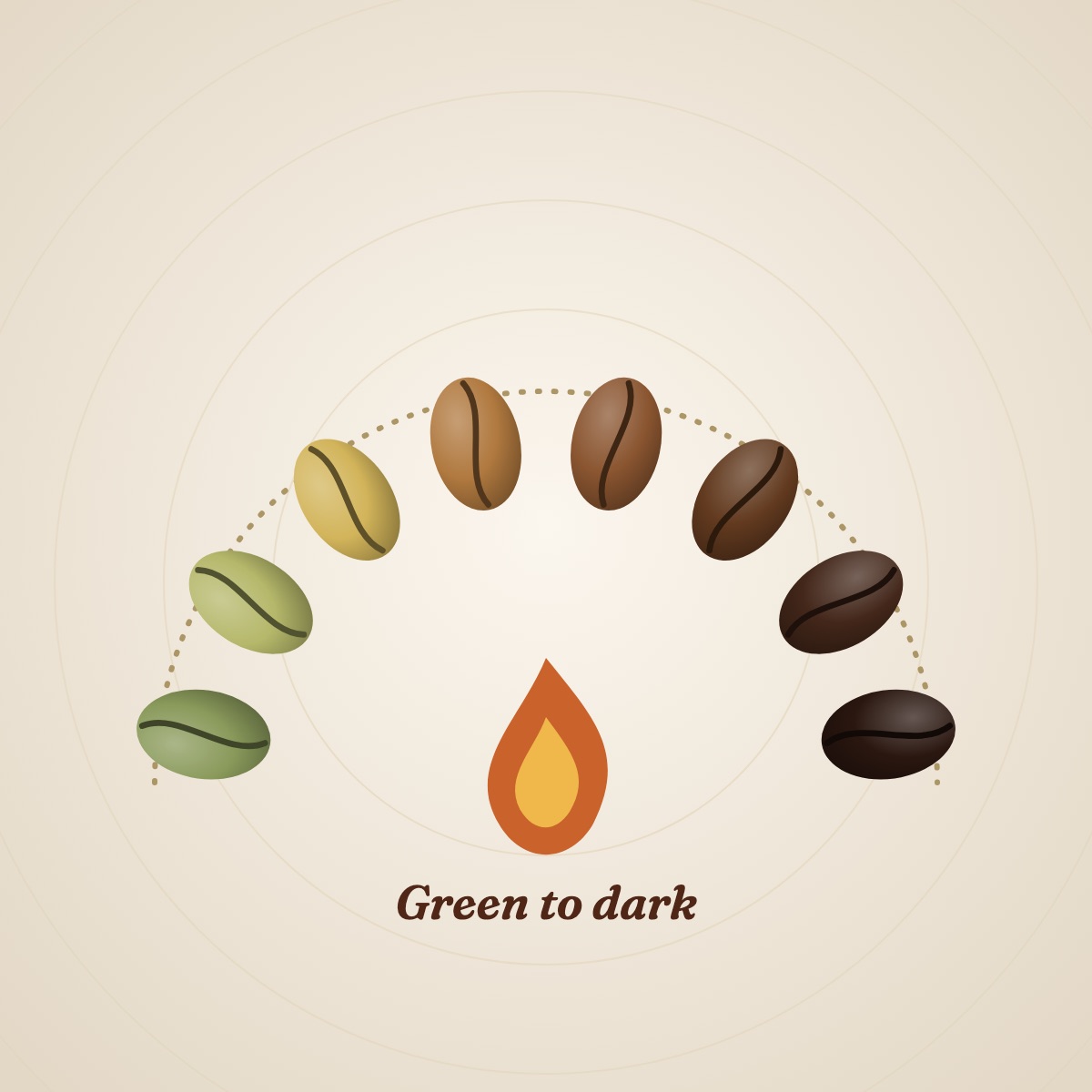
Green coffee is a dense, grassy-smelling seed. Heat drives out water, triggers browning reactions, makes the beans expand and crack, and creates hundreds of aroma compounds. A typical roast takes about 8–15 minutes and the beans lose roughly 12–20% of their weight, mostly water. Sugar, acids and other compounds change at each stage, so when you apply heat matters as much as how much.
Your result depends on four things you can control (heat, airflow, time and batch size) and three you can only manage through buying: bean density, moisture and processing. See density and moisture and processing methods.
The roast in stages
| Stage | What you see and smell | Roughly when |
|---|---|---|
| Drying | Green turns yellow; grassy, hay-like smell | From charge to about 150 °C |
| Maillard browning | Yellow to light brown; bread, toast, caramel | About 150–195 °C |
| First crack | Audible popping; beans expand | Around 196 °C |
| Development | Sweetness builds, acidity softens | From first crack to drop |
| Second crack | Quieter crackle; oils appear | Around 224 °C and above |
Read the detail in coffee roasting stages and the first to second crack guide.
Roast profiles: shaping the curve
A roast profile is the record of bean temperature over time, plus the changes you make to heat and airflow. Roasters usually describe it in three phases (drying, Maillard and development) and track the rate of rise (RoR) to keep the curve smooth. Learn more in roast profiles explained, rate of rise and development time ratio.
- Bean temperature vs environmental temperature: two different probes that tell you different things. See BT vs ET.
- Charge temperature and batch size: set by your roaster, bean density and goal.
- Airflow: moves heat and chaff; more airflow can brighten, less can add body.
Roast levels and flavour
Light roasts keep origin character, florals and acidity; medium roasts balance sweetness and body; dark roasts add chocolate and smoky notes with more bitterness. Roast level is not the same as strength or caffeine. See roasting levels, light vs dark roast and does roast level change caffeine.
Roast defects and how to fix them
The most common faults are baked (flat), scorched or tipped (burnt edges) and underdeveloped (sour, grassy). Most come from heat applied too early, a stalled rate of rise or too little development. See roast defects 101, and the fixes for specific processes: washed, natural, honey, anaerobic, wet-hulled and decaf.
Roasting different beans
Each bean type asks for a slightly different approach:
- Robusta: denser, bitter and low in sugar. See how to roast Robusta and our Indonesia Robusta guide.
- Ethiopian: small, dense and floral. See how to roast Ethiopian coffee.
- Brazil and Latin America: sweet, chocolatey bases for milk drinks. See Brazil and Latin American roasting.
- Blends: pre-roast vs post-roast blending.
After the roast: cooling, resting and tasting
Cool beans quickly to stop the reaction, then let them degas. Most roasters rest filter coffee a few days and espresso a little longer. See resting roasted coffee. Cup every new profile against a reference using a simple protocol: sample roasting for cupping and the cupping guide.
Equipment, climate and running a roastery
Your roaster type shapes how heat reaches the beans: see coffee roaster types. In Malaysia’s heat and humidity you also need to manage ambient conditions: roasting in Malaysia. Planning to roast commercially? Read how to start a coffee roastery in Malaysia. For consistent results, follow the best practices for roasters, and for beginners the home roasting tips.
Where to buy green coffee for roasting
Great roasting starts with good green coffee. Scofi supplies unroasted Arabica and Robusta from local Malaysia stock, with moisture checks, spec sheets and samples. See how to buy, quality control, moisture levels and Scofi Malaysia supplier.
FAQ: Coffee bean roasting
How long does it take to roast coffee beans?
Most roasts take roughly 8–15 minutes in a commercial roaster, depending on batch size, roast level and profile. Sample roasters are often a little faster.
What temperature is first crack?
Around 196 °C bean temperature, though it varies by roaster, probe and bean. See the first crack guide.
What is the best roast level for Arabica?
Arabica generally shines from light to medium, but the best level depends on your customers and drinks. See roasting levels.
How much weight do beans lose when roasted?
Typically about 12–20%, mostly water, with darker roasts losing more.
Why does my coffee taste flat or baked?
Usually a stalled or too-low rate of rise, or too long a roast. See roast defects 101.
How long should I rest roasted coffee?
Commonly a few days for filter and a little longer for espresso. See resting roasted coffee.
Can I roast coffee at home?
Yes, with equipment made for roasting and its safety instructions. See home roasting tips.
Where can I buy green coffee beans for roasting in Malaysia?
Scofi supplies green Arabica and Robusta from local stock with samples and delivery. See how to buy.
