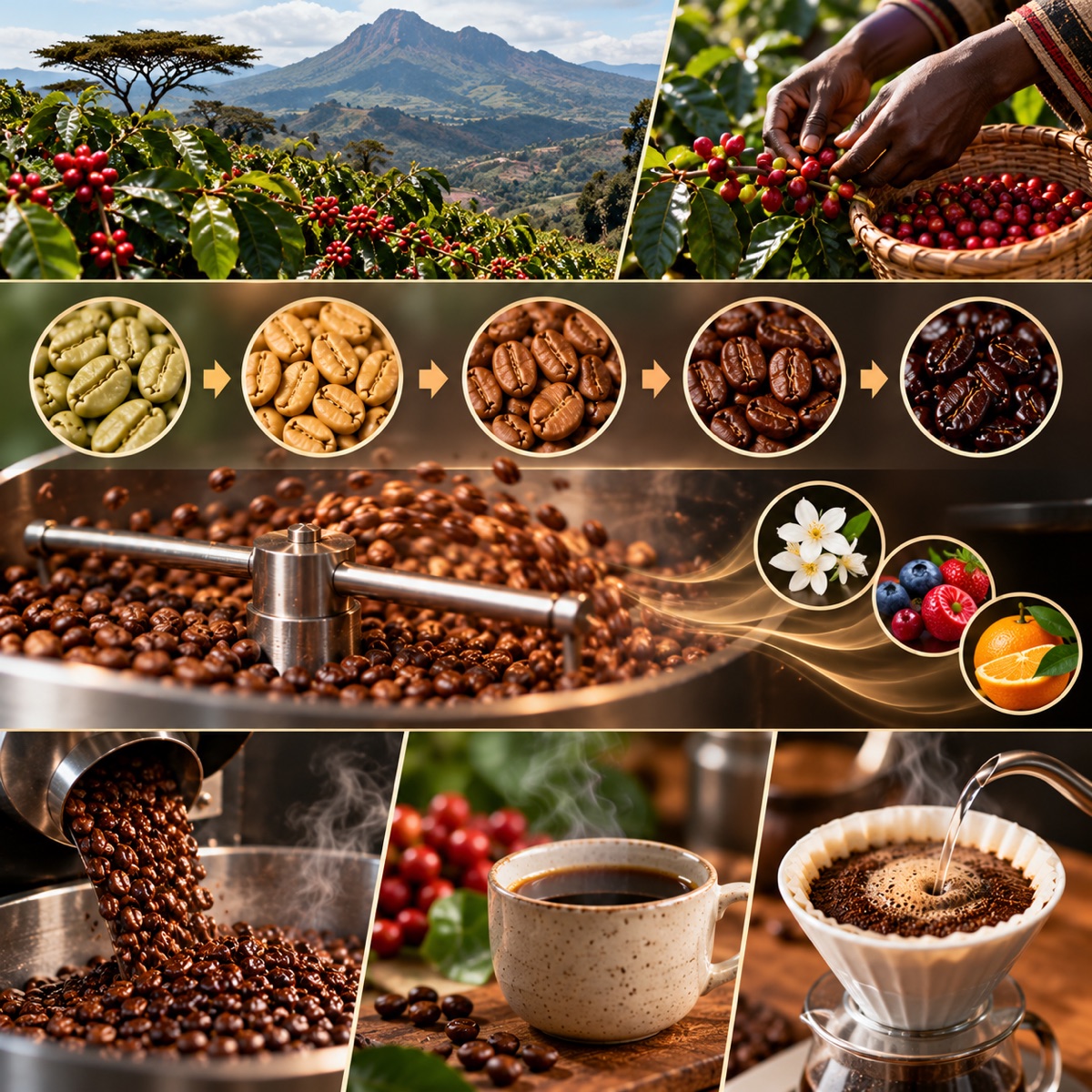
Why Ethiopian coffee roasts differently
Ethiopian lots are often small, dense, high-grown beans with delicate aromatics such as jasmine, bergamot, lemon and stone fruit. High density means they absorb heat slowly, yet the aromatics are fragile and can be lost with heavy development. The challenge is to heat the beans evenly without baking or scorching. See Ethiopia origin, altitude impact and density and moisture.
Roasting washed Ethiopian coffee
Washed Ethiopians such as Yirgacheffe and Sidama give clean, floral, citrus and tea-like cups.
- Charge: confident, but not so hot that the small beans scorch.
- Maillard phase: steady and smooth to build sweetness. Avoid a stall.
- Development: enough to remove sourness but not so long that florals fade.
- Finish: usually light to light-medium for filter clarity.
See roasting washed Arabica for a detailed profile approach.
Roasting natural Ethiopian coffee
Naturals such as Guji and Harrar show berry, tropical fruit and cocoa, but carry more surface sugars and variable moisture.
- Start gently to avoid scorching sugars.
- Keep airflow clean so fruit stays bright, not smoky.
- Watch for baked or fermented notes and extend development only as needed.
See roasting natural process coffees and natural processing.
| Factor | Washed | Natural |
|---|---|---|
| Typical flavour | Jasmine, bergamot, citrus, tea-like | Berry, tropical fruit, cocoa |
| Roast tendency | Clean and clear; light to light-medium | Gentler start; light to medium |
| Main risk | Grassy, sour or baked | Scorching, fermented notes |
Choosing a roast level
For filter, light to light-medium shows florals and acidity. For espresso, a little more development rounds acidity and texture. Always cup to find the point where sweetness appears without losing aroma. See roasting levels, development time ratio and espresso roast vs filter roast.
Brewing Ethiopian coffee
Filter methods highlight clarity: start near 1:16 and 92–96 °C, then adjust. See filter brew Arabica and espresso. Pair a floral Ethiopian with a chocolate-nut Brazil to educate guests: see Brazil and Latin American roasting.
Common problems and fixes
- Grassy or sour: underdeveloped; extend development slightly.
- Flat, dull: baked; add energy earlier. See roast defects 101.
- Scorched tips on small beans: lower the charge temperature or early heat.
FAQ: Roasting Ethiopian coffee
What roast level is best for Ethiopian coffee?
Usually light to medium for filter. See roasting levels.
Why do Ethiopian beans scorch easily?
Small, dense beans can overheat on the surface if the charge or early heat is too high.
Should I roast washed and natural differently?
Yes. Naturals usually need a gentler start and careful airflow.
How do I keep the florals?
Avoid over-development and keep a smooth rate of rise.
How long should Ethiopian coffee rest?
Often a few days. See resting roasted coffee.
Is Ethiopian coffee good for espresso?
Yes, with a bit more development; naturals suit aromatic espresso and iced drinks.
What brew ratio should I start with?
Around 1:16 for filter and 1:2 for espresso, then adjust.
Where can I buy Ethiopian green coffee in Malaysia?
Scofi can shortlist Ethiopian lots from local stock. See how to buy.
