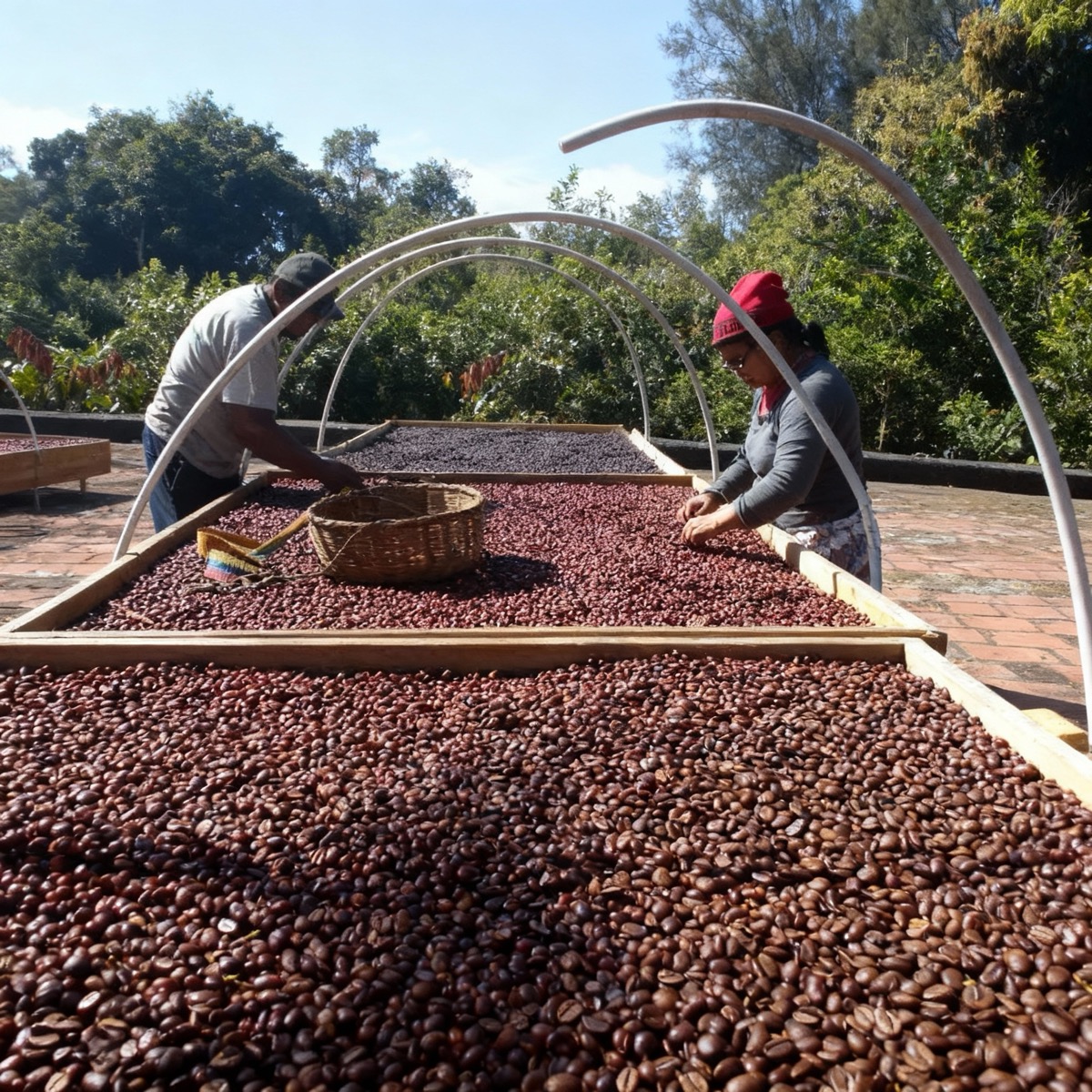
Why choose naturals — fruit intensity, texture & story
Naturals accentuate fruit and body. By drying the cherry around the seed, sugars and volatiles can influence the cup, pushing berry-jammy to tropical directions with silkier mouthfeel than many washed lots. They also work where water is scarce, and they create visually engaging narratives for café menus (“raised-bed sun-drying,” “slow-dry natural”). The trade-off is that naturals demand tight sorting and slow, even drying to avoid defects.
- Fruit & aroma: Berry, tropical, and wine-like notes when cleanly dried.
- Texture: Often rounder body and sweetness; great for espresso features.
- Water-Light: Less water use; suitable for dry harvest climates.
Natural process — the step-by-step workflow
High-performing naturals start with ripe-only picking and end with thorough conditioning of the dried seed. Below is a reference flow and how each decision shows up in the cup.
| Stage | Key Actions | Cup Impact |
|---|---|---|
| Reception & Sorting | Remove floaters/under/overripe; hand/optical triage. | Reduces ferment risk and astringency from unripe fruit. |
| Spread & Layering | Thin layers (2–4 cm), frequent turning; remove damaged cherries. | Even moisture loss → clean fruit, less mouldy/phenolic notes. |
| Drying Control | Shade nets in peak sun; cover in rain; maintain airflow on raised beds/patios. | Protects aromatics; avoids case-hardening and smoky notes. |
| Target Moisture | Dry to ~10–12% seed moisture; rest in conditioning silos. | Stable storage/roast; reduces quakers and uneven extraction. |
| Hulling & Sorting | Hull dried cherry; size/density screens; colour sort; hand pick. | Removes defects that would taste woody/ferment or astringent. |
Risk map — where defects sneak in
Naturals are vulnerable to over-fermentation, mould, and phenolic taints if cherries dry too slowly or unevenly. Thick layers trap humidity; sudden rain without covers promotes mould; case-hardening (dry shell, wet core) locks moisture in, creating boozy off-notes later. Clean stations prevent this with thin layers, turning schedules, airflow, and shade/rain management, followed by thorough sorting pre-bagging.
- Over-Ferment: Keep layers thin; remove damaged fruit quickly; ensure nighttime airflow.
- Mould/Earthy: Cover beds in rain; never stack wet cherry; sanitise patios and rakes.
- Phenolic/Smoky: Avoid diesel/wood-smoke exposure; use clean, ventilated drying zones.
Regions using naturals — styles & seasonal notes
Natural processing thrives in dry harvest seasons with reliable sun and airflow. Profiles vary by elevation and cultivar, but fruit-forward signatures are common when QC is strong.
| Region/Country | Usage | Typical Cup Direction |
|---|---|---|
| Brazil (Cerrado/Sul de Minas) | Extensive patio/raised-bed naturals | Chocolate-nut base, red fruit, balanced body |
| Ethiopia (natural lots) | Smallholder raised-bed naturals | Berry, floral, tropical, tea-like finish |
| El Salvador | Estate naturals with slow drying | Stone fruit, cocoa, gentle wine-like notes |
| Indonesia (dry-season naturals) | Selective naturals where climate permits | Spiced fruit, fuller body; strict drying needed |
| PNG | Smallholder naturals in dry windows | Sweet citrus, dried fruit, medium body |
How naturals taste — brewing & roast baselines
Expect ripe fruit aromatics (strawberry/blueberry/tropical), round sweetness, and heavier mouthfeel. For filter, naturals shine with gentle agitation and slightly lower extraction targets to keep fruit clean. For espresso, naturals can produce dense, dessert-like shots—coarsen slightly and widen ratios to control viscosity and avoid over-ripeness expression.
Filter baseline
1:16, 92–94 °C, medium grind; pulse pours; limit turbulence.
Espresso baseline
~18 g → 42–48 g in 28–34 s; coarser than washed to keep fruit bright.
Milk guidance
Pairs well with milk in small/medium ratios; preserves fruit-chocolate balance.
Buying naturals — reading offer sheets & managing risk
Prioritise ripe-only picking, thin-layer drying, and turning schedules. Ask for average drying days, rain/cover protocol, shade use, and arrival moisture/activity. Clean naturals often show fewer quakers and steadier extraction. For feature menus, target raised-bed naturals with meticulous sorting; for blends, Brazil patio naturals can anchor sweetness and body.
Spec snapshot — evaluating natural lots
| Parameter | Target | Why It Matters |
|---|---|---|
| Picking | Ripe-only; multiple passes | Reduces unripe astringency, cleaner ferment |
| Layering | 2–4 cm; frequent turning | Even drying; avoids mould/phenolics |
| Covers | Rain covers; shade in peak sun | Prevents re-wetting and case-hardening |
| Moisture | ≈10–12% | Roast stability; shelf life in humid climates |
How Scofi helps — cup-verified naturals from Malaysia stock
As Scofi (Soo Hup Seng Trading Co Sdn Bhd), we shortlist natural-process green coffee by flavour target and menu role, re-check moisture/screen/cup on arrival in Malaysia, and keep retention samples to support repeatability. We’ll help you integrate naturals into blends or launch them as fruit-forward features with confidence.
- Traceable proposals with drying protocol and QC notes.
- Packaging guidance (GrainPro/vacuum) for humid storage.
- Roast/brew baselines to accelerate R&D on your water and grinder.
FAQ: Natural (Dry) Coffee Processing
1) What defines a natural-process coffee?
Whole cherries are sun-dried intact before hulling. No depulping/fermentation tanks—quality depends on ripeness, thin layers, turning, airflow, and sorting.
2) Why do naturals taste fruitier?
Drying with the cherry skin/pulp intact can enhance fruit-forward aromatics and sweetness when drying is even and clean.
3) What are the biggest risks?
Over-fermentation, mould/earthy notes, phenolic/smoky taints, and case-hardening from thick layers or re-wetting during rain.
4) How long should drying take?
Climate-dependent; typically 15–30+ days on raised beds for high quality. Faster drying risks defects; too slow invites mould/ferment.
5) Are naturals harder to roast?
They can be. Start with protective charge, steady Maillard, and avoid scorching; aim for balanced development to keep fruit clean, not cooked.
6) Do naturals suit espresso?
Yes—often excellent. Use slightly coarser grind and wider ratios (e.g., 1:2.3–1:2.6) to prevent heaviness and highlight fruit sweetness.
7) What should be on the offer sheet?
Picking policy (ripe-only), bed/patio details, layer thickness, turning schedule, rain/cover protocol, drying days, and arrival moisture (~10–12%).
8) Are naturals more sustainable?
They use less water than washed, but require diligent sanitation and space. Good practices include clean patios, shade nets, and effluent control if any washing occurs.
9) How do I cup for defects?
Watch for boozy/volatile ferment, musty/mouldy, rubber/phenolic. Compare hot-warm-cool to catch late-appearing faults.
10) Can Scofi supply clean naturals now?
Yes. Share your flavour target and volume; we’ll shortlist clean naturals from Malaysia stock, send samples, and arrange delivery or pickup.
