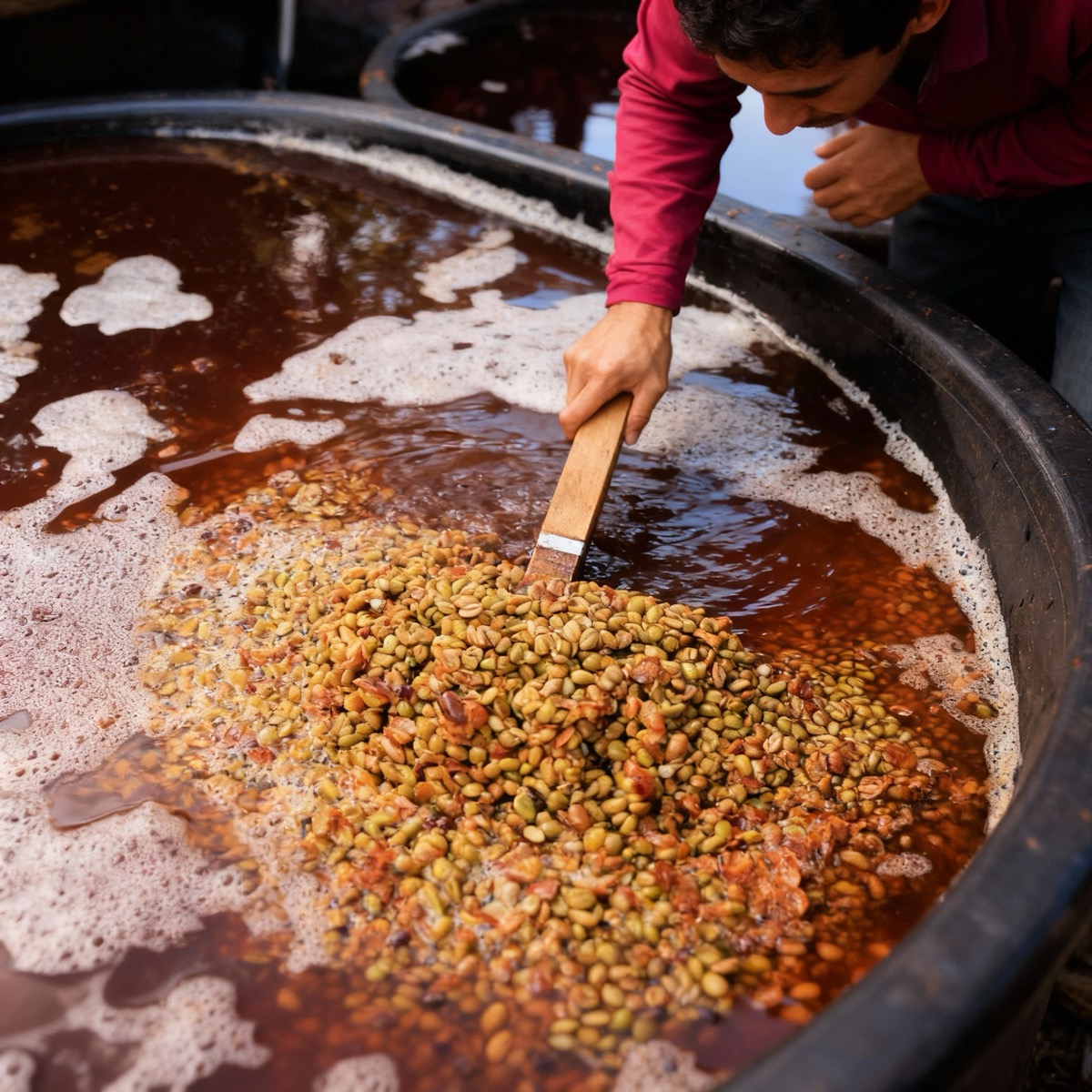
Why wet processing? — clarity, consistency & terroir
Wet processing prioritises clarity over fruit intensity. By removing sticky mucilage before drying, producers reduce uncontrolled fermentation and spotlight variety, altitude, and soil. The cup profile skews toward citrus, florals, stone fruit with a crisp finish. Compared with naturals, washed coffees typically have cleaner flavour separation and lower risk of ferment/phenolic taints when QC is strong.
- Clean cup: Lower ferment risk; brighter acidity; transparent origin character.
- Predictable: Process control enables consistent results across lots and seasons.
- Versatile: Great for daily filter, competition-style clarity, and espresso with snap.
Fermentation & washing — the step-by-step workflow
Each mill tunes details to its climate and water constraints, but the core stages are similar. Below is a reference flow and what each decision changes in the cup.
| Stage | Key Actions | Cup Impact |
|---|---|---|
| Reception & Sorting | Remove floaters/under/overripe fruit; hand/optical sort. | Reduces defects; narrows ripeness band for even fermentation. |
| Depulping | Mechanical removal of skins; adjust pressure to avoid parchment damage. | Cleaner tanks; less sugar carryover reduces off-notes risk. |
| Fermentation | Dry, wet, or semi-wet; native yeasts or selected cultures; 8–36 h typical. | Extent/type of fermentation shapes acidity, mouthfeel, and aromatic lift. |
| Washing | Channel or mechanical washing until “squeaky clean” parchment feel. | Removes mucilage and microbial residues → clarity, less variability. |
| Soaking (optional) | Clean-water soak (e.g., Kenyan style) for 8–24 h. | Heightens tartaric/phosphoric lift; tighter acidity and sweetness. |
| Drying | Raised beds/patios/mechanical; thin layers, turning, rain covers. | Even moisture loss preserves aromatics; avoids phenolics and fade. |
| Resting & Milling | Stabilise in parchment; hull, size, density sort, colour sort. | Uniform roast behaviour; reduced quakers; consistent extraction. |
The microbiology — what fermentation actually does
In wet processing, microbes digest pectins and sugars in mucilage. Yeasts dominate early, producing alcohols/esters; lactic bacteria may add roundness and sweetness; excessive acetic bacteria risks sharp vinegar notes. Temperature, pH, and oxygen affect which microbes thrive. Producers manage this with tank depth, agitation, inoculation (selected cultures), and strict sanitation. The goal isn’t heavy flavour creation—it’s controlled cleanup that sets up a clear, sweet cup.
- Time/Temp: Cooler nights extend clean ferment; high temps need shorter schedules.
- Water hygiene: Clean inflow/outflow limits off-flavour contamination and defects.
- Sanitation: Scrub tanks and channels; biofilms can seed off-notes between batches.
Water use & environment — doing washed right
Classic washed mills used significant water. Modern stations reduce impact via eco-pulpers, recirculation, and settling ponds that treat effluent before release. Buyers should ask how water is managed; clean practices safeguard quality and local ecosystems. Efficient systems are not only better for the environment—they often improve cup cleanliness by maintaining hygienic conditions throughout the workflow.
Where wet processing is common — regional snapshots
Washed processing is widely adopted where water access and infrastructure allow. Profiles vary by altitude and cultivar, but the clean, bright signature is a throughline.
| Region/Country | Usage | Typical Cup Direction |
|---|---|---|
| Ethiopia (washed lots) | Extensive in co-ops and private stations | Floral, citrus, tea-like clarity with delicate sweetness |
| Kenya | Washed + soaking (double/triple) | Blackcurrant, grapefruit, phosphoric snap |
| Colombia | Farm-level washed; diverse microclimates | Balanced fruit, caramel, crisp acidity |
| Central America (CR/Guatemala) | High adoption at altitude | Citrus, stone fruit, cane sweetness |
| Rwanda/Burundi | Washed with careful drying | Red fruit, floral spice, tea-like finish |
| PNG | Smallholder washed; variable logistics | Sweet citrus, herbal florals, medium body |
Clean, bright taste — what to expect & how to brew
Expect clear acidity (citrus, malic, phosphoric depending on origin), transparent aromatics (floral/herbal), and refined sweetness (cane/honey). For filter, washed coffees reward lighter end-temperatures and gentle agitation; for espresso, keep ratios slightly wider to maintain clarity without harshness.
Filter baseline
1:16–1:17, 92–95 °C, medium-fine; pulse pours protect structure and clarity.
Espresso baseline
~18 g → 40–45 g in 28–33 s; coarser than chocolatey profiles to open florals.
Milk guidance
Use small ratios (≤1:2.5) or feature as straight shots to preserve brightness.
Buying washed lots — reading offer sheets & managing risk
For washed coffees, scrutinise sorting, fermentation, washing, soaking, and drying logs. Confirm arrival moisture (~10–12%), water management, and resting time in parchment. Prioritise current-crop arrivals to protect aromatics in Malaysia’s climate. Taste the same sample across two roast curves (clarity vs sweetness) to find your café’s best expression.
Offer matching
We shortlist washed lots by acidity shape and flavour goals.
QC on arrival
We re-check moisture/screen/cup and keep retention samples for verification.
Ops & logistics
Local sampling, domestic delivery, and packaging advice for humidity.
How Scofi helps — cup-verified washed coffees from Malaysia stock
As Scofi (Soo Hup Seng Trading Co Sdn Bhd), we curate traceable green coffee washed lots matched to your menu role—daily filter, feature pour-over, or bright espresso. We manage local samples, verify arrivals, and guide roast/brew baselines so your team can move from sample to launch smoothly.
- Traceable proposals with fermentation, washing, and drying notes.
- Packaging guidance (GrainPro/vacuum) to protect clarity post-arrival.
- Launch planning synced to regional harvest calendars.
FAQ: Wet (Washed) Coffee Processing
1) What’s the main goal of wet processing?
To remove mucilage via controlled fermentation and washing, reducing uncontrolled microbial effects and emphasizing clarity and acidity.
2) How long should fermentation take?
Commonly 8–36 hours depending on temperature, altitude, and method (dry/wet/semi-wet). Cup results matter more than a fixed number.
3) What is the Kenyan soaking step?
An optional clean-water soak after washing (8–24 h) that refines acidity and sweetness; often called “double/triple soaking.”
4) Are yeasts or bacteria added on purpose?
Some mills inoculate with selected cultures for predictability; many rely on native microbiota managed by sanitation and time/temperature control.
5) Does washed always beat natural for quality?
Not necessarily—washed emphasizes clarity; well-made naturals can be superb. Choose based on menu role and defect risk tolerance.
6) How do I verify a washed lot’s quality on paper?
Request sorting steps, fermentation style/duration, washing/soaking details, drying logs, and arrival moisture (~10–12%).
7) What defects are common if washing is weak?
Phenolic/ferment notes, vegetal astringency, and inconsistent extraction due to uneven drying or residual mucilage.
8) How should I roast washed coffees?
Protect charge, even Maillard, finish light–medium for filter clarity. For espresso, extend development slightly to stabilise texture.
9) Do washed coffees work in milk drinks?
Yes, but smaller ratios preserve brightness. Large milk volumes can mute delicate aromatics; consider feature filters or espresso flights.
10) Can Scofi supply washed lots now?
Yes—we’ll shortlist washed coffees from Malaysia stock, send samples, and arrange domestic delivery or pickup.
