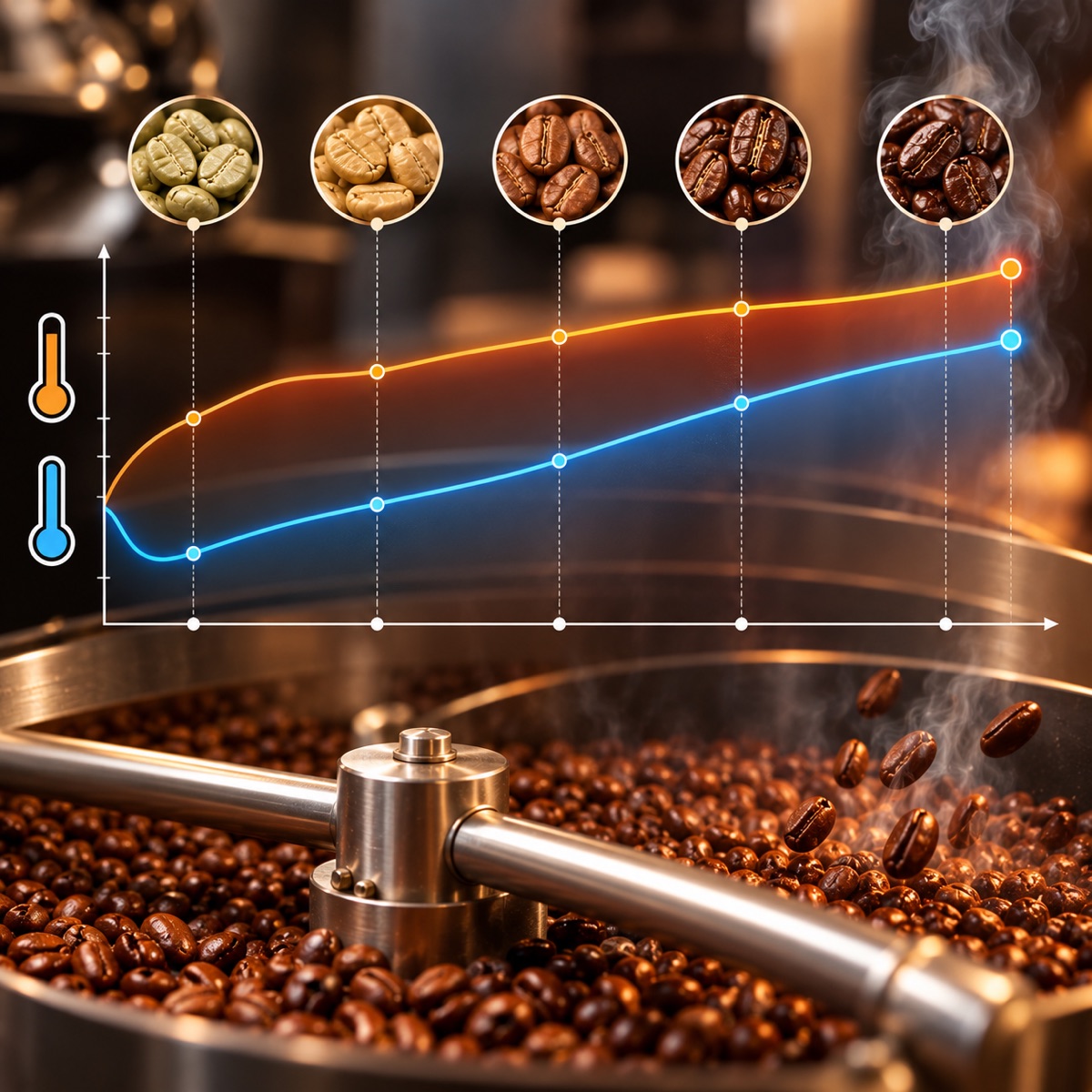
What BT and ET measure
Bean temperature (BT) comes from a probe placed in or near the moving bean mass. It reflects how hot the beans are. Environmental temperature (ET) comes from a probe measuring the air in the drum or roasting chamber, depending on the machine. It reflects the heat energy surrounding the beans. Because probe type, position and response speed differ, readings are not directly comparable between roasters.
| Feature | Bean temperature (BT) | Environmental temperature (ET) |
|---|---|---|
| Measures | The beans | The drum or chamber air |
| Reacts to burner changes | Slowly | Quickly |
| Used for | Roast stage, first crack, drop point | Heat energy, stability, troubleshooting |
| Risk | Probe not buried in beans reads wrong | Position and airflow change readings |
Why BT and ET differ
Hot air changes temperature faster than a mass of beans. At charge, ET is high and BT drops sharply as cool beans absorb energy. As the roast progresses, BT rises while ET may stay steady or fall. The gap between them tells you how much energy is going into the beans. See roast profiles explained for the turning point and phases.
Probe placement and calibration
- BT probe: keep it in the beans, not in air gaps, and in a consistent position.
- ET probe: check its location and response time.
- Calibrate: check probes against a reference and replace worn ones.
- Log consistently: compare roasts only when probes and roaster settings are the same.
How to use BT and ET together
Roasters often track rate of rise (the change in BT per minute) and watch ET to anticipate changes. If ET falls too fast, the beans may lose energy and the rate of rise may stall. If ET is very high relative to BT early on, the surface may scorch. Use ET to understand why the rate of rise moves. See rate of rise and roast defects 101.
Roaster type and ambient effects
Drum, air and hybrid roasters transfer heat differently, so BT/ET relationships vary. See coffee roaster types. Warm, humid air also changes intake conditions, so log ambient readings, especially in Malaysia. See roasting in Malaysia’s heat and humidity.
Common mistakes
- Comparing BT numbers between different roasters.
- Burying the probe in the wrong place or using a worn probe.
- Chasing ET without watching BT and rate of rise.
- Not logging ambient temperature, batch size and settings.
Start from the step-by-step roasting guide and the main roasting guide.
FAQ: BT vs ET
What does BT stand for in coffee roasting?
Bean temperature, the temperature of the coffee beans measured by a probe.
What does ET stand for?
Environmental temperature, the temperature of the air in the drum or roasting chamber.
Which is more important, BT or ET?
Both. BT shows roast progress; ET shows available heat. Use them with rate of rise.
Why does BT drop at charge?
Cool beans absorb heat from the hot drum, so BT falls before reaching the turning point.
Can I compare temperatures between roasters?
Only as general guides, since probes and positions differ.
How often should I calibrate probes?
Check them regularly and replace them if readings drift or look inconsistent.
Does ambient temperature affect roasting?
Yes, especially intake air and starting conditions. Log it every roast.
What is a good gap between BT and ET?
It depends on the roaster. Learn your own typical pattern and watch for changes.
