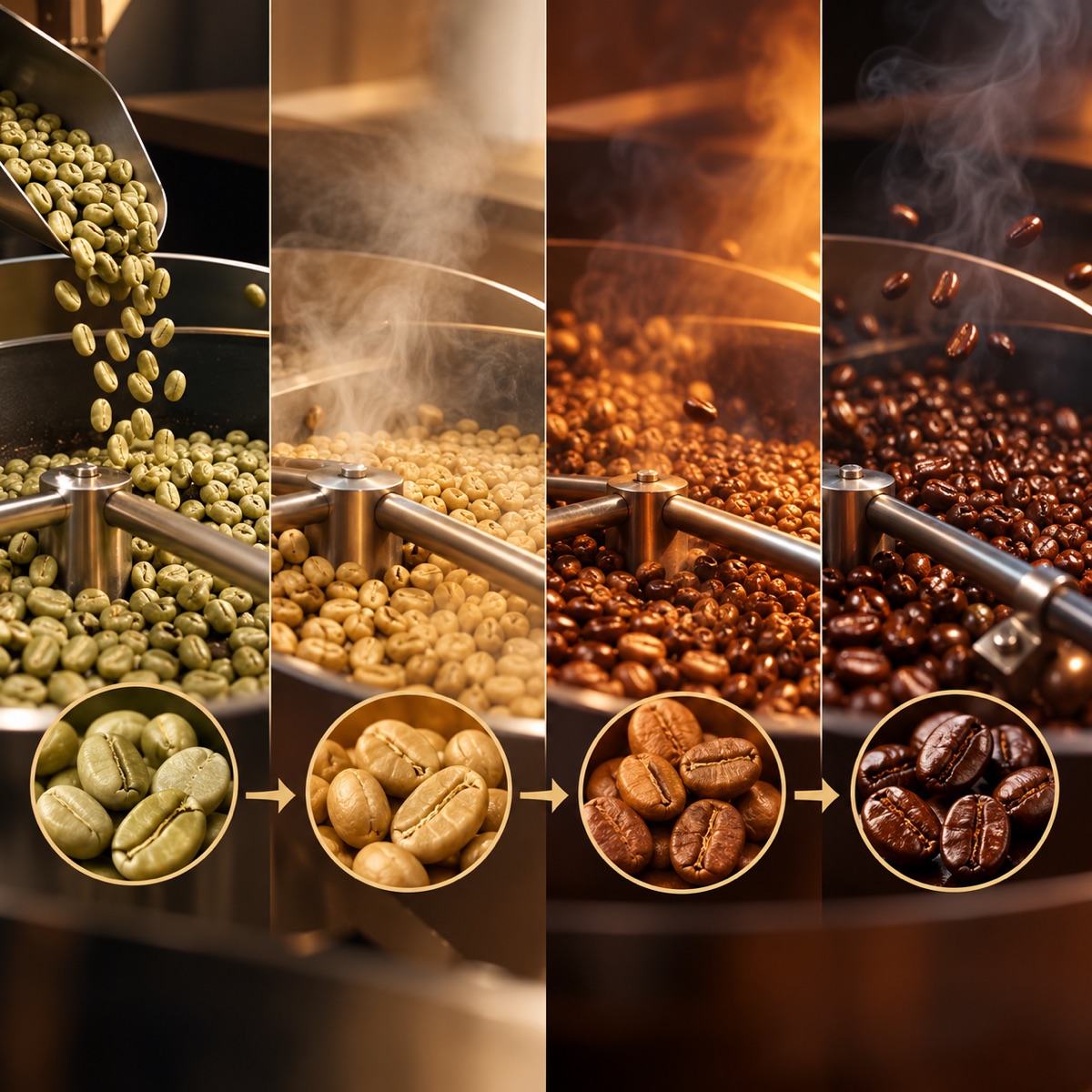
What a roast profile shows
A profile plots bean temperature (BT) against time, often alongside environmental temperature (ET) and the rate of rise (RoR). It also records your heat and airflow settings. Two roasts with the same colour can taste different because the path to that colour differed. A profile lets you describe, compare and repeat that path.
Phase 1: drying
After the charge, beans lose moisture and turn from green to yellow. The turning point appears here. Enough energy is needed to prepare the beans for browning, but too much can scorch the surface. Dense, high-moisture beans usually need more energy than low-density ones. See density and moisture.
Phase 2: Maillard browning
Browning reactions between sugars and amino acids build colour and aromas such as toast, caramel and nuts. A longer Maillard phase tends to give more body and sweetness, while a shorter one can taste brighter but riskier. The aim is a smooth, controlled rise, not a stall.
Phase 3: development
Development begins at first crack and ends when you drop the beans. It softens acidity and builds sweetness and body. Too short and the coffee tastes sour and grassy; too long and it tastes flat and roasty. Measure it with development time ratio and learn the sounds in the first to second crack guide.
| Phase | If shorter | If longer |
|---|---|---|
| Drying | Risk of scorching and uneven roast | Flat, baked flavour if too slow |
| Maillard | Brighter but less sweet | More body and sweetness; baked if stalled |
| Development | Sour, grassy, underdeveloped | Roasty, flat, lower acidity |
The key points on the curve
- Charge temperature: the temperature at which beans enter the roaster.
- Turning point (TP): the lowest bean temperature after charge.
- Yellowing: the end of drying, when beans turn yellow.
- First crack (FC): audible cracking that starts development.
- Drop temperature and time: when roasting stops.
Read more about the probes in bean temperature vs environmental temperature.
How to adjust a profile
Change one variable at a time and taste the result.
- Roast tastes sour or grassy: extend development a little, or raise energy earlier.
- Roast tastes flat or baked: avoid a stalled rate of rise; add heat earlier or shorten the roast.
- Roast tastes harsh or burnt: reduce charge heat or early airflow imbalance.
See roast defects 101 and rate of rise.
Profiles for different coffees
Different coffees need different curves: washed Arabica, naturals, honey, anaerobic, wet-hulled, decaf and Robusta. Compare espresso and filter roast styles.
FAQ: Roast profiles
What are the three phases of a roast?
Drying, Maillard browning and development.
What is the turning point?
The lowest bean temperature after the charge, before temperature starts rising again.
Is a longer roast always better?
No. Longer can add body but also risks flat or baked flavours. Balance matters.
What does BT mean in roasting?
Bean temperature, measured by a probe in the roasting drum. See BT vs ET.
How do I know if my profile is good?
Cup it against a reference and check that it is sweet, clear and balanced.
Can I copy a profile from another roaster?
Use it as a starting point only, because machines, batch sizes and beans differ.
How many roasts should I test per change?
Compare at least two roasts per change, changing one variable at a time.
What is the best profile for Arabica?
There is no single best profile. It depends on the bean, roast level and brew method. See roasting levels.
