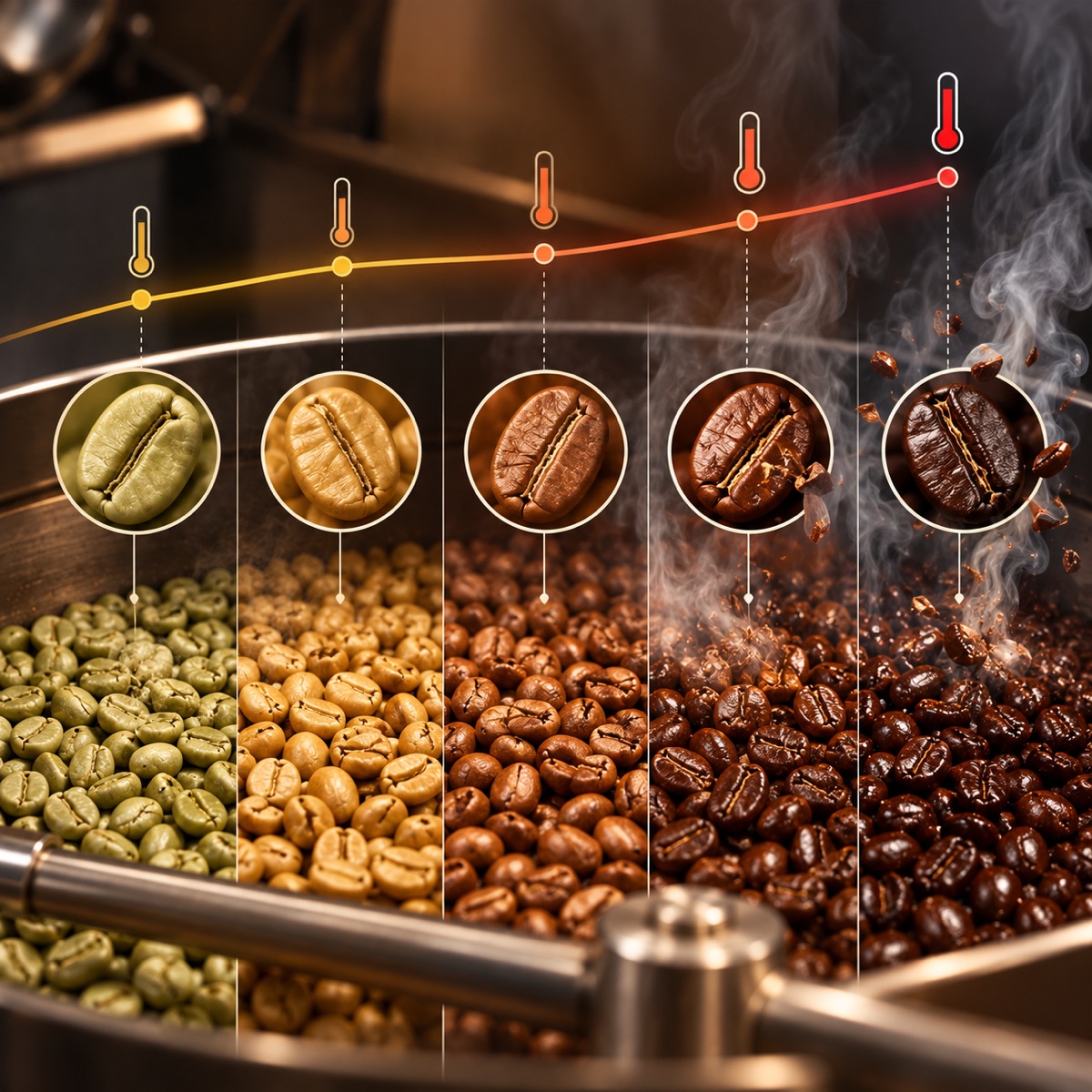
What is first crack?
Inside the bean, pressure from steam and gases builds until the cell structure fractures with an audible pop. This is first crack. It marks the point where the roast turns from endothermic (absorbing heat) to exothermic and where development begins. Beans swell, chaff flies off, and the aroma changes from bready to sweeter.
What is second crack?
If you continue roasting, a second, quieter and more rapid crackle starts as the bean’s cellulose structure breaks down further. Oils begin to move to the surface, and the cup shifts towards roasty, smoky and bittersweet flavours, with less origin character. Most specialty roasters stop before second crack.
Temperature and timing at a glance
| Event | Approx. bean temperature | Sound | What it means |
|---|---|---|---|
| Start of first crack | About 196 °C (385 °F) | Popcorn-like popping | Development begins |
| End of first crack | About 205–210 °C | Pops fade | Light to medium range |
| Start of second crack | About 224 °C (435 °F) | Fast, quiet crackle | Dark roast territory |
| Rolling second crack | About 230 °C and above | Continuous crackle | Very dark roast |
Time between the cracks depends on your heat settings, but first crack to second crack often takes a few minutes.
Choosing a drop point by roast level
| Roast level | Typical drop point | Cup tendency |
|---|---|---|
| Light | Shortly after first crack begins to end | Bright, floral, clear |
| Medium | After first crack finishes, well before second | Balanced sweetness and body |
| Medium-dark | Just before or at the start of second crack | Chocolate, low acidity |
| Dark | In second crack | Smoky, bitter, heavy body |
See roasting levels and light vs dark roast.
Managing the roast around first crack
First crack is the most important moment to control. Do not let the rate of rise crash or flick as crack begins, since that tends to give baked or harsh flavours. Reduce energy gradually and watch the development time. See rate of rise and development time ratio.
Hearing and recording the cracks
- Listen: use a quiet room, or a microphone on the roaster, for a clear start of first crack.
- Mark it: log the time and bean temperature at the start of first crack and the drop.
- Note the difference: Robusta’s first crack is often quieter, so rely on temperature and colour too. See how to roast Robusta.
- Use colour and smell: check against the roasting stages chart.
FAQ: First and second crack
What temperature is first crack?
Usually around 196 °C (385 °F) bean temperature, varying by roaster and probe.
What temperature is second crack?
Around 224 °C (435 °F), again depending on your equipment.
Is first crack louder than second crack?
Yes. First crack sounds like popcorn popping; second crack is a quieter, faster crackle.
Should I stop before second crack?
For most specialty light and medium roasts, yes. Dark roasts continue into or beyond second crack.
How long after first crack should I drop?
It depends on roast level and DTR. See development time ratio.
Why can’t I hear first crack?
Noise, small batches, or Robusta’s quieter crack. Use temperature and colour as backups.
Does first crack temperature change with altitude of the beans?
Denser, high-grown beans often crack later or more sharply, but the reading also depends on your probe.
Do all beans have the same first crack temperature?
No. Density, moisture and processing change it. See density and moisture.
