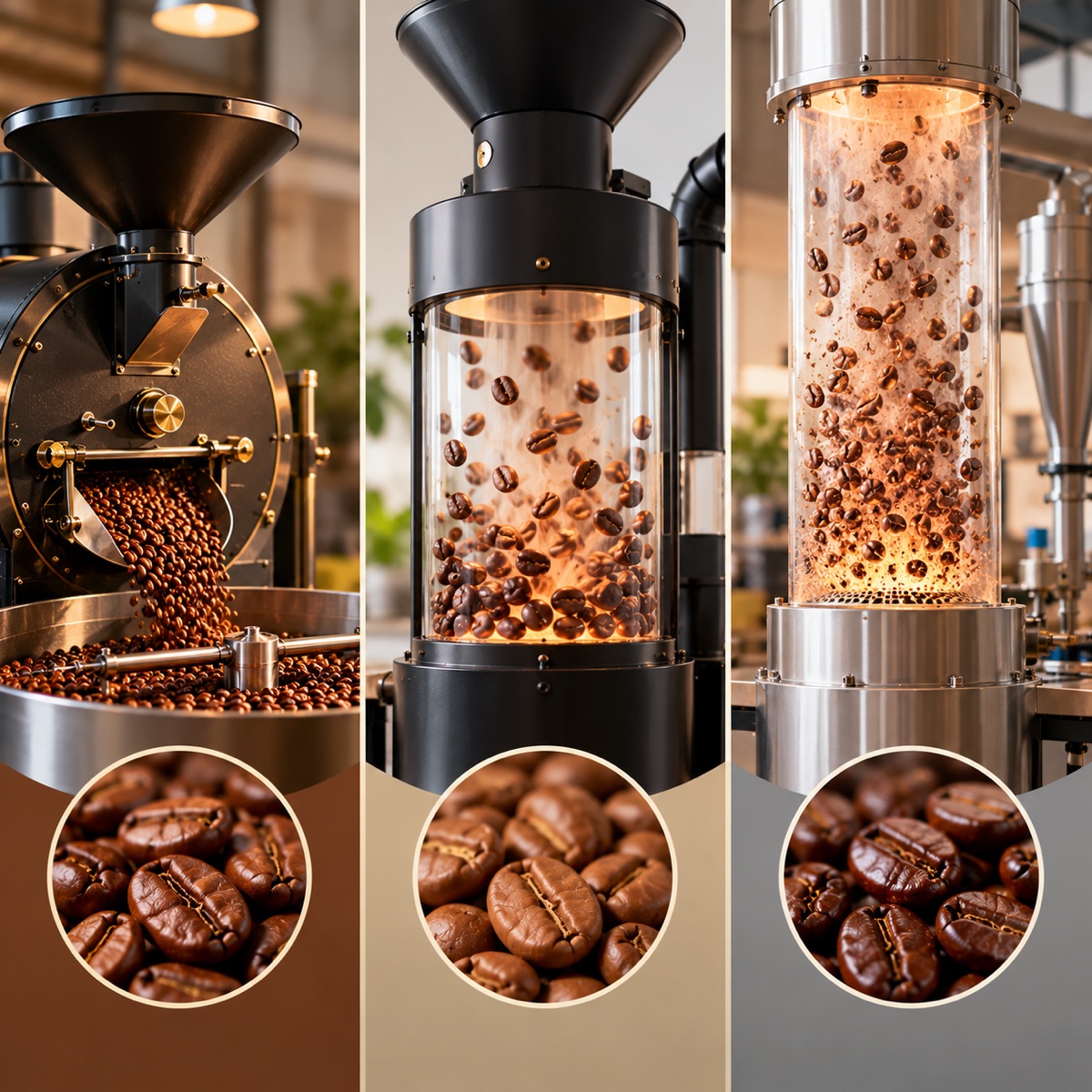
How roasters transfer heat
Every roaster heats beans by a mix of conduction (contact with hot metal), convection (hot air flowing over beans) and radiation (heat radiated from surfaces). Roaster types differ mainly in how much of each they use, and how easily you can control it. That shapes flavour tendencies, but the roaster’s operator and the green coffee matter just as much. See roast profiles explained.
Drum roasters
A rotating drum tumbles beans while hot air passes through. Heat comes from the drum wall and air. Drum roasters have thermal mass, which makes them stable and forgiving, and many roasters like them for body and sweetness.
- Strengths: forgiving, popular, wide range of sizes, good for espresso and filter.
- Watch-outs: slower to respond to heat changes; scorching or tipping if charged too hot.
- Typical use: cafés and production roasteries from small batches upwards.
Air roasters (fluid-bed)
Hot air blows upwards through the chamber, lifting and tumbling the beans. Heat is mostly convection, so roasts can be fast and flavours often clear and bright.
- Strengths: fast response, clean flavour, good for sample roasting and small batches.
- Watch-outs: limited batch sizes in many models; chaff handling; smaller thermal mass can swing with ambient changes.
- Typical use: sample roasting, home and small-batch roasting.
Hybrid roasters
Hybrid roasters add extra airflow control to a drum design, or combine drum and air elements, so roasters can adjust convection more precisely. They aim for the stability of a drum with the flexibility of air.
| Feature | Drum | Air (fluid-bed) | Hybrid |
|---|---|---|---|
| Main heat | Conduction + convection | Convection | Mixed, more airflow control |
| Flavour tendency | Body, sweetness | Clarity, brightness | Adjustable |
| Response | Slower, stable | Fast | Moderate |
| Batch size | Small to large | Often small | Small to medium |
| Best for | Espresso, general roasting | Samples, clarity profiles | Roasters wanting control |
How to choose a roaster
- Volume now and in 2 years: pick a size you can grow into.
- Flavour goals: body and sweetness, or clarity.
- Budget: include installation, ventilation, afterburner or emissions equipment if needed, training and service.
- Premises and power: gas or electric, ventilation and space. See start a coffee roastery in Malaysia.
- Software and probes: logging BT, ET and RoR helps. See BT vs ET and rate of rise.
- Support: local training and spare parts.
Sample roasters vs production roasters
A small sample roaster lets you test lots before buying and cup consistently: see sample roasting for cupping. Production roasters make your sales volume. Keep results comparable by logging both and knowing how each behaves.
Safety and maintenance
Roasters involve high heat, flammable chaff and smoke. Follow the manufacturer’s manual, clean the chaff collector and exhaust regularly, never leave a roast unattended and keep appropriate fire-safety equipment. See best practices for roasters and home roasting tips.
FAQ: Coffee roaster types
Which roaster is best for beginners?
A well-supported small drum or air roaster, chosen for your batch size and with good training.
Is a drum roaster better than an air roaster?
Neither is better overall. Drum suits body and stability; air suits clarity and fast samples.
What is a fluid-bed roaster?
A roaster where hot air lifts and heats the beans, also called an air roaster.
What is a hybrid roaster?
A roaster that combines drum and extra airflow control for flexible heat transfer.
What size roaster should I buy?
Choose one that fits your current volume with room to grow.
Do roasters need ventilation?
Yes. Smoke and chaff need safe exhaust. Follow the manual and local rules.
What is a sample roaster?
A small roaster used to test green coffee lots before buying.
Where do I buy green coffee for any roaster?
Scofi supplies green Arabica and Robusta in Malaysia. See how to buy.
