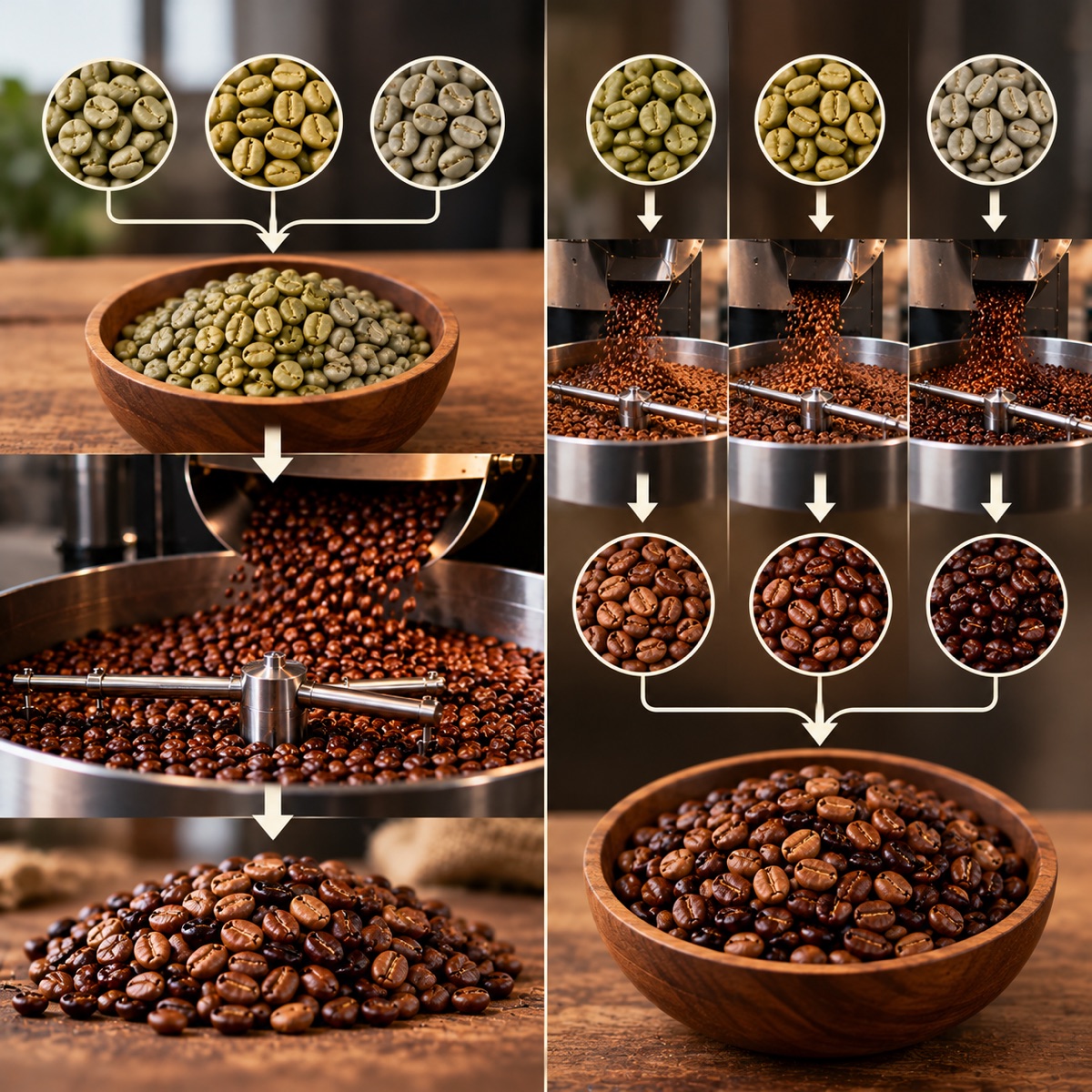
What is blending in coffee roasting?
A blend combines two or more coffees to create a flavour, body and price that a single origin cannot. Most café espresso is a blend, designed for sweetness, crema and consistency, especially in milk drinks. You can combine the coffees before roasting (pre-roast, as green beans) or after roasting (post-roast, as roasted beans). See espresso Arabica for blend design.
Pre-roast blending
In pre-roast blending, you weigh and mix the green coffees, then roast them together as one batch.
- Pros: one roast run per batch, less work, a very consistent blend, simple inventory.
- Cons: different beans roast differently, so one profile may suit one component and not another; harder to fine-tune each coffee.
- Works best when: components have similar density, size and moisture.
Post-roast blending
Here you roast each coffee separately to its own best profile, then mix the roasted beans in set ratios.
- Pros: full control over each component, easy to adjust ratios, can use very different beans.
- Cons: more roast runs, more storage, more work and more chance of inconsistency if components differ in freshness.
- Works best when: components differ in density or roast needs, such as Arabica with Robusta.
| Factor | Pre-roast | Post-roast |
|---|---|---|
| Roast runs | One per blend batch | One per component |
| Control of each bean | Low | High |
| Consistency | Often very good | Depends on process |
| Workflow | Simple | More complex |
| Best for | Similar beans | Different beans or fine control |
Blending Arabica and Robusta
Robusta is denser and often roasted differently from Arabica. Many roasters blend post-roast so each can reach its best profile, though some blend pre-roast for simplicity. A common starting point is a small Robusta share in milk-heavy blends, adjusted in 2–3% steps. See Arabica vs Robusta, how to roast Robusta and the Indonesia Robusta guide.
Designing a blend: roles, not just origins
- Base: a chocolate-nut coffee for body and sweetness, such as Brazil. See Brazil and Latin American roasting.
- Lift: a washed coffee for acidity and clarity.
- Texture: optionally a small share of Robusta for crema.
- Keep the story simple for the menu board and stable for bar workflow.
Keeping blends consistent
Weigh every component, log roast data, keep retention samples and re-cup each new batch against the last. For post-roast blends, blend components with similar roast dates. See best practices for roasters and resting roasted coffee.
FAQ: Pre-roast vs post-roast blending
Which is better, pre-roast or post-roast blending?
Neither wins always. Pre-roast is simpler; post-roast gives more control.
Can I roast Arabica and Robusta together?
You can, but they have different density and needs, so many roasters blend them post-roast.
Does blending after roasting cost more?
It usually means more roasts and more storage, so more time and labour.
How do I keep a blend consistent?
Weigh components, log roasts and re-cup each batch against a reference.
How much Robusta should I use?
Often around 5–20% in milk-heavy blends; test and adjust in small steps.
Should blend components have the same roast date?
Ideally close, so they degas and age together.
Can single origins be blended after roasting?
Yes, that is the usual way to build a house blend with flexible ratios.
Where can I buy components for blends?
Scofi supplies green Arabica and Robusta in Malaysia. See how to buy.
