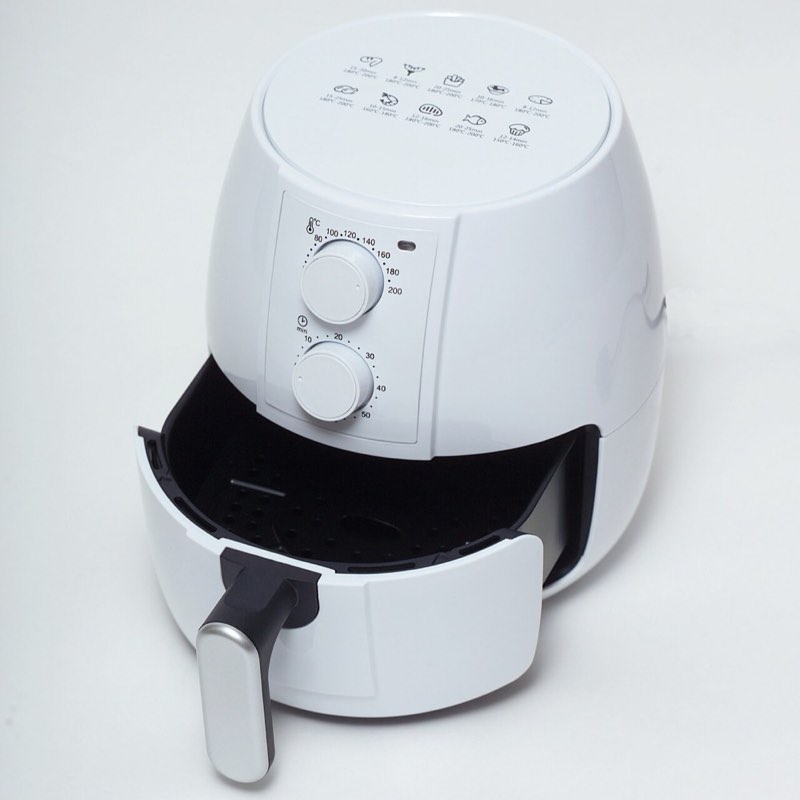
Is it a good idea to roast coffee in an air fryer?
An air fryer circulates hot air around food, which is similar in principle to a hot-air coffee roaster. That is why people try it. However, air fryers are not designed for coffee. Many have poor temperature control, they have no way to read the bean temperature, the basket is not designed to stir beans, and the chaff (the papery skin that comes off beans) can blow around and catch fire. Use it as a low-cost experiment, not as a long-term roasting setup. If you roast often, a small purpose-built roaster is safer and more consistent. See coffee roaster types.
Safety first
- Do not leave it unattended. Stay beside the air fryer for the whole roast.
- Roast outdoors or in a very well-ventilated area. Roasting makes smoke and strong smells. Use an extractor fan or open windows.
- Deal with chaff. Chaff is flammable. Empty it and clean the basket and heating element regularly. Do not let it build up.
- Keep it away from curtains, paper and wiring.
- Use heat-safe containers for cooling. Roasted beans are hot.
- Check the manual. Using an air fryer for roasting may void the warranty, and some models may overheat.
- Do not overfill. Keep to a small batch so the beans can move.
- If it smells of burning plastic or smoke becomes heavy, switch off and unplug.
What you need
- An air fryer with a basket that can reach around 200 °C
- Green coffee beans (80–100 g to start)
- A kitchen scale
- A timer
- A colander or two metal bowls for cooling and removing chaff
- Oven gloves
- A fan or open space for ventilation
- A notebook or the roast log template
Step-by-step: roasting in an air fryer
1. Weigh the beans. Start with 80–100 g of green coffee. Choose a forgiving bean such as a Brazilian or a Honduran Arabica. 2. Preheat. Run the air fryer at about 180–200 °C for a couple of minutes. 3. Add the beans. Put the beans in the basket in a single, thin layer. 4. Roast and shake. Set a timer and shake or stir the beans every 30–60 seconds so they roast evenly. Some people use a metal spoon or tongs. 5. Watch the stages. The beans go from green to yellow and tan, release steam, then turn brown. See roasting stages. 6. Listen for first crack. At around 7–10 minutes you may hear a popping sound. For a light-medium roast, stop 1–2 minutes after the first crack starts. Longer gives a darker roast. See first crack to second crack. 7. Cool quickly. Pour the beans into a metal colander and toss them or use two bowls and a fan, until they are cool. 8. Remove chaff by blowing gently or tossing outdoors. 9. Rest. Store loosely for 12–24 hours, then in an airtight container. Taste after 1–2 days. See resting roasted coffee. 10. Record the batch. Write down the weight in and out, time, temperature, first crack time and taste.
Typical timing and results
| Stage | Typical time | What you see |
|---|---|---|
| Drying | 0–4 min | Green to yellow, grassy smell |
| Browning | 4–8 min | Tan to light brown, sweet toasty smell |
| First crack | 7–11 min | Popping sound |
| Light-medium finish | 1–2 min after first crack starts | Light brown, dry surface |
| Medium-dark | 3–4 min after first crack starts | Darker, some oil near second crack |
Air fryers vary widely, so use sight, smell and sound, not the clock alone. Measure your weight loss: for an 80 g batch, expect roughly 68–70 g of roasted coffee. Use the roast loss calculator.
Common problems and fixes
- Uneven roast (light and dark beans): shake more often and use a smaller batch.
- Scorched or tipped beans: lower the temperature and reduce the batch size. See roast defects.
- Underdeveloped, grassy cup: the roast was too short or too cool. Roast a little longer.
- Too much smoke: improve ventilation. Dark roasts smoke more.
- Beans fly out: use a basket with a lid or a mesh cover if the model allows.
- Weak first crack: old beans or too low a temperature. See does green coffee go bad.
What air fryer roasting cannot do
You cannot measure bean temperature, control airflow separately from heat, or run a precise profile. That means you cannot reliably repeat a roast profile, manage rate of rise or fine-tune development time. For those, you need a roaster designed for coffee.
Better alternatives
- A small home coffee roaster gives control and safer chaff collection.
- A hot-air popcorn popper is a classic cheap method, but also needs care.
- Buying freshly roasted beans from a roaster if you do not want to roast.
See green coffee beans for beginners and home roasting tips.
FAQ: Roast coffee in an air fryer
Can you roast coffee beans in an air fryer?
Yes, in small batches with regular shaking, but it is less controlled and carries safety risks. A purpose-built roaster is better.
How long does it take to roast coffee in an air fryer?
Roughly 8–14 minutes for an 80–100 g batch, depending on the machine, temperature and roast level.
What temperature should I use?
Many people use about 180–200 °C. Air temperature is not the same as bean temperature, so go by colour, smell and first crack.
Is it safe to roast coffee in an air fryer?
It can be if you stay beside it, ventilate well and clear chaff. Chaff can ignite, so it is a real fire risk.
How much coffee can I roast at once?
Start with 80–100 g so beans can move freely.
Does the coffee taste good?
It can, especially with forgiving beans, but results are less even than a proper roaster.
Will roasting damage my air fryer?
It may leave smoke, oil and chaff residue and could void the warranty. Clean it thoroughly.
Where can I buy green coffee for home roasting in Malaysia?
Scofi supplies unroasted coffee, depending on availability and quantity. Contact us.
