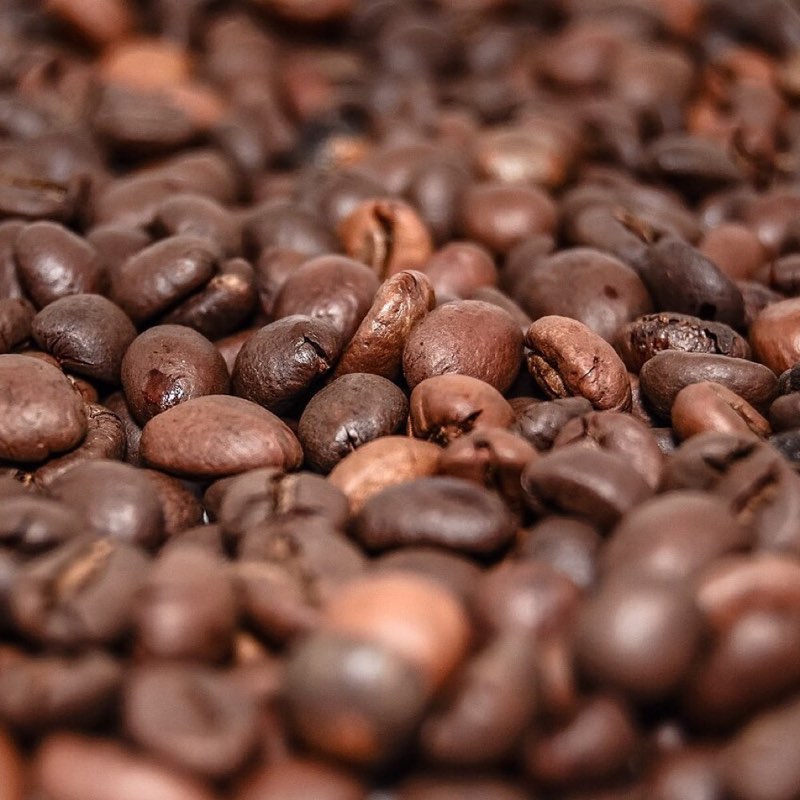
The four types of coffee beans
Coffee beans are the seeds of coffee plants, and there are four main species. Only two, Arabica and Robusta, matter for most commercial coffee.
| Type | Taste | Caffeine (typical) | Grown at | Best use |
|---|---|---|---|---|
| Arabica | Sweet, aromatic, bright acidity | About 1.2–1.5% | High altitude | Specialty, filter, espresso, café menus |
| Robusta | Strong, bitter, earthy, thick crema | About 2.2–2.7% | Low to mid altitude | Espresso blends, kopi, instant coffee |
| Liberica | Smoky, woody, fruity | Varies | Lowland, hot climates | Niche, local specialities |
| Excelsa | Tart, fruity | Varies | Lowland, hot climates | Blends, niche lots |
Figures are typical ranges and vary by lot. See Arabica vs Robusta and Liberica.
Arabica: the quality leader
Arabica is the most widely grown species and the one most associated with quality. It is delicate, grows at altitude and offers the widest range of flavour. Read the full guide: Arabica coffee beans in Malaysia, and see the main varieties such as Typica, Bourbon and Geisha.
Robusta: strength and crema
Robusta is hardier, higher in caffeine and cheaper. It gives crema, body and a bold taste, and is the backbone of Malaysian kopi. See Indonesia Robusta, Vietnam Robusta and fine Robusta.
Liberica and Excelsa: the rare types
These two are produced in small amounts, mostly in Southeast Asia and parts of Africa. Their taste is bold and unusual. Excelsa is now classed as a variety of Liberica. See Liberica coffee.
Other ways coffee beans are "typed"
- By origin: Ethiopia, Brazil, Colombia, Sumatra and others each have their own style. See growing regions.
- By process: washed, natural or honey. See processing methods.
- By grade: screen size and defects. See grading standards.
- By roast: light, medium and dark. See roasting levels.
- Green or roasted: see unroasted vs roasted.
Which type should you choose?
- Café with milk drinks: an Arabica base, with a little Robusta for body. See Robusta in espresso blends.
- Kopitiam or traditional coffee: Robusta. See Robusta for coffee shops.
- Filter or specialty menu: high-grown Arabica.
- Budget blends and instant coffee: Robusta.
Cost your blend with the blend cost calculator.
Arabica and Robusta in detail
| Feature | Arabica | Robusta |
|---|---|---|
| Species | Coffea arabica | Coffea canephora |
| Share of world coffee | Roughly 60% | Roughly 40% |
| Caffeine (typical) | About 1.2–1.5% | About 2.2–2.7% |
| Sugar and lipids | Higher | Lower |
| Chlorogenic acids | Lower | Higher (more bitter) |
| Altitude | Often 1,000–2,000 m | Often sea level to about 800 m |
| Disease resistance | Lower | Higher |
| Price | Usually higher | Usually lower |
Figures vary by lot and source, so treat them as typical ranges. Arabica's higher sugar and lipid content helps explain its sweetness, while Robusta's higher caffeine and chlorogenic acids explain its bitterness and strength. See Arabica vs Robusta and coffee caffeine content.
Popular Arabica varieties
Inside Arabica there are many varieties. Typica and Bourbon are the old base varieties. Caturra and Catuaí are compact mutations and crosses with higher yields. Geisha (Gesha) is prized for floral aromatics, and SL28 and SL34 are famous Kenyan selections. Catimor and its relatives are rust-resistant lines used widely in Asia. Read the Arabica varieties guide and the pages on Typica, Bourbon, Caturra coffee beans, Catuaí, Geisha and SL28 and SL34.
Robusta types and where they grow
Robusta grows in Vietnam, Indonesia, Uganda, India, Brazil (as Conilon) and parts of West Africa. Quality ranges from basic natural Robusta to washed and fine Robusta. See Vietnam Robusta, Indonesia Robusta, Robusta grading and fine Robusta. For price, see Robusta coffee price in Malaysia.
Bean size and grade: another way to classify beans
Within any species, beans are sorted by size (screen size) and by defects. Large, uniform beans roast evenly and are often priced higher. Peaberries are rounder single beans and are sold as a separate class. Grades such as AA (Kenya), SHG (Central America), Grade 1 (Ethiopia) and EK-1 (Indonesia Robusta) all describe size and defects in their own way. Read grading standards and Grade 1 vs EK-1.
Types of coffee beans that Scofi lists
Scofi lists unroasted Arabica and Robusta from several origins on its product pages. For example, you can browse a Timor Arabica, a Brazil Santos, an Ethiopia Yirgacheffe and more. Listings change with the crop, so check the product pages for current lots and contact Scofi for samples and a quotation.
Common myths about coffee bean types
- "Arabica is always better." Not always. Quality depends on grade, processing and roast.
- "Robusta is only for instant coffee." Robusta is widely used in espresso blends and Malaysian kopi. See is Robusta coffee bad.
- "Dark roast is a type of bean." Roast level is a process, not a species. See roasting levels.
- "Single origin means better." It means one origin. It can be excellent or ordinary.
FAQ: Types of coffee beans
What are the four types of coffee beans?
Arabica, Robusta, Liberica and Excelsa.
Which type of coffee bean is best?
It depends on the use. Arabica is best for flavour and acidity, Robusta for strength and crema.
What is the most common type of coffee bean?
Arabica is the most widely grown, followed by Robusta. Together they make up almost all coffee traded.
Which coffee bean has the most caffeine?
Robusta has about twice the caffeine of Arabica.
What type of coffee bean is used in Malaysian kopi?
Mostly Robusta, often roasted dark. See kopitiam coffee.
What are coffee varieties?
Varieties are subtypes within a species, such as Typica, Bourbon, Geisha and SL28 in Arabica. See varieties.
Are green and roasted beans different types?
No. They are the same bean before and after roasting. See unroasted vs roasted.
Where can I buy different types of coffee beans in Malaysia?
Scofi supplies unroasted Arabica and Robusta, depending on availability. Contact us.
Which has more caffeine, Arabica or Robusta?
Robusta has roughly twice the caffeine of Arabica by weight.
Is Liberica a type of coffee bean?
Yes. Liberica is the third main coffee species, with large, irregular beans and a smoky, fruity taste. See Liberica coffee.
What is Excelsa coffee?
Excelsa is a rare coffee now classed as a variety of Liberica. It is tart and fruity and used in blends.
What are peaberry coffee beans?
Peaberries are round single beans formed when a cherry develops one seed instead of two. They are sorted and sold separately, and some people think they taste more concentrated.
Which type of coffee bean is best for beginners?
A medium-roast Arabica, such as a balanced Brazil or Colombia coffee, is an easy place to start. See Brazil coffee beans and Colombia coffee beans.
