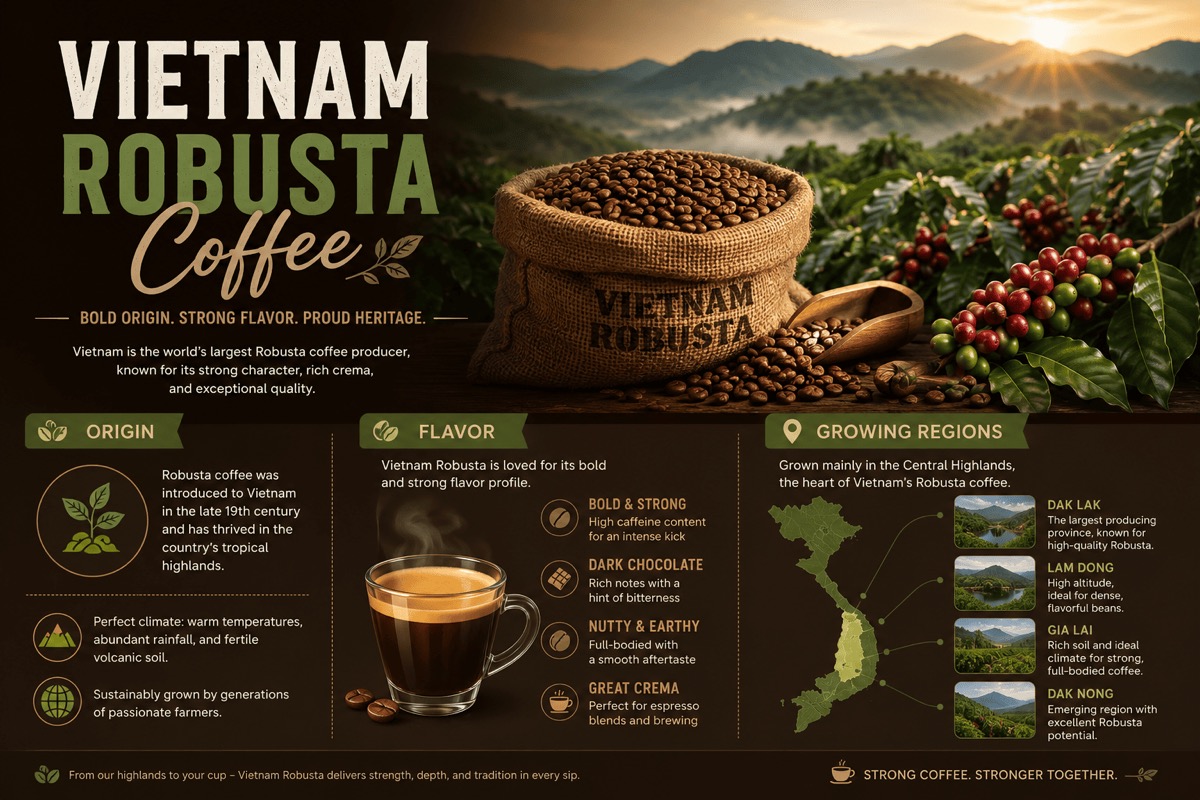
What is Vietnam Robusta coffee?
This complete guide explores the origin of Vietnam Robusta Coffee, its common flavour profile, major growing regions such as Đắk Lắk, Đắk Nông, Gia Lai, Lâm Đồng, and Kon Tum, as well as the processing methods and quality factors cafés, roasters, hotels, distributors, and wholesale buyers should check before purchasing green Robusta coffee beans.
Vietnam Robusta Coffee refers mainly to coffee produced from the Coffea canephora species, commonly known as Robusta. Compared with Arabica, Robusta plants are generally more tolerant of warm conditions, can grow at lower elevations, and often produce higher yields under suitable farm management. These characteristics have helped Robusta become the dominant coffee species grown in Vietnam.
The country’s Robusta industry serves several different markets. Commercial grades are used in instant coffee, large-volume blends, extraction, foodservice, and manufacturing. Higher-quality Vietnam Robusta Coffee, sometimes described as fine Robusta, may be produced using more selective harvesting, controlled fermentation, careful drying, improved sorting, moisture management, and protective storage.
The difference between ordinary and high-quality Vietnam Robusta Coffee can be significant. A clean lot may present cocoa, roasted nuts, malt, spice, a dense body, and a controlled dark-chocolate bitterness. A poorly prepared lot may show rubbery, musty, medicinal, smoky, mouldy, or excessively astringent flavours. This is why buyers should evaluate specifications, samples, cup quality, and supplier practices rather than judging the coffee by origin alone.
- Bold flavour: Vietnam Robusta Coffee commonly delivers cocoa, roasted nuts, spice, cereal, and dark chocolate notes.
- Heavy body: Its dense mouthfeel helps the coffee remain noticeable in espresso, milk drinks, iced beverages, and sweetened coffee.
- Multiple quality levels: Buyers can find everything from commercial-grade coffee to cleaner and more carefully processed fine Robusta.
Origin and history of Vietnam Robusta coffee
Coffee was introduced to Vietnam during the nineteenth century. Over time, cultivation expanded into areas with suitable climate, land, and farming conditions. While Arabica was planted in cooler and higher-altitude locations, Robusta became much more widely cultivated because it adapted well to the warmer conditions of Vietnam’s major agricultural regions.
The growth of Vietnam Robusta Coffee was closely linked to the development of the Central Highlands. Provinces such as Đắk Lắk, Đắk Nông, Gia Lai, Lâm Đồng, and Kon Tum became important coffee centres. Their upland plateaus, seasonal rainfall, farming communities, and agricultural infrastructure supported the expansion of production, collection, milling, warehousing, and export.
Vietnam Robusta Coffee became important to the international market because it could support high-volume demand. It was widely used by instant coffee manufacturers, commercial roasters, espresso producers, foodservice operators, and coffee traders. This large and established supply base helped Vietnam become strongly associated with dependable Robusta availability.
In more recent years, many Vietnamese producers and exporters have focused on improving quality. Better cherry selection, controlled processing, raised-bed drying, traceability, moisture monitoring, defect reduction, and specialty-style evaluation have opened more opportunities for premium Vietnam Robusta Coffee. As a result, roasters can now find lots intended not only for commercial blends but also for quality-focused espresso, single-origin Robusta, and specialty beverage menus.
Vietnam Robusta coffee flavour profile
The typical Vietnam Robusta Coffee flavour profile is bold, full-bodied, and lower in perceived acidity than many high-grown Arabica coffees. Common tasting notes include dark chocolate, cocoa powder, roasted nuts, malt, cereal, brown spice, and earthy depth. The final flavour depends on variety, farm management, cherry ripeness, processing, drying, storage, roast profile, and brewing method.
Body and mouthfeel
One of the main strengths of Vietnam Robusta Coffee is its dense body. In espresso, it can create a heavier and more concentrated mouthfeel. In milk drinks, iced coffee, or sweetened beverages, the coffee can remain noticeable even after milk, ice, condensed milk, syrup, or sugar is added.
Acidity and bitterness
Vietnam Robusta Coffee generally presents lower perceived acidity than Arabica. Its bitterness is usually more pronounced, but clean bitterness should be separated from harshness. A quality lot may show a structured dark-chocolate bitterness, while lower-grade coffee may taste medicinal, rubbery, burnt, woody, or excessively astringent.
Aroma and finish
Clean Vietnam Robusta Coffee may offer aromas of cocoa, roasted peanut, malt, brown spice, dark caramel, and toasted grain. More carefully processed lots can show dried fruit, fermented sweetness, or a cleaner chocolate finish. The aftertaste is often long and intense, which makes Robusta useful when a buyer wants strong flavour persistence.
Common Vietnam Robusta coffee tasting notes
- Dark chocolate: a deep cocoa-like bitterness associated with clean Robusta.
- Roasted nuts: peanut, hazelnut, or toasted nut characteristics.
- Malt and cereal: grain-like sweetness and a comforting finish.
- Brown spice: mild pepper, clove, woody spice, or cinnamon-like depth.
- Earthy character: a grounded flavour that can add weight to blends.
- Dried fruit: possible in selected natural or controlled-fermentation lots.
| Sensory Category | Common Characteristics | Quality Consideration | Typical Use |
|---|---|---|---|
| Aroma | Cocoa, roasted nuts, malt, spice | Avoid rubbery, smoky, chemical, or musty aromas | Espresso blends and milk drinks |
| Body | Heavy, dense, creamy | Should feel structured rather than rough or drying | Latte, iced coffee, traditional Vietnamese coffee |
| Acidity | Low to moderate | Clean balance matters more than strong brightness | Mainstream and lower-acidity-style profiles |
| Bitterness | Dark chocolate and cocoa-like | Harsh bitterness may indicate defects or poor roasting | Strong espresso and sweetened coffee drinks |
| Finish | Long, intense, roasted-nut finish | Should remain clean without excessive astringency | Blends requiring strong flavour persistence |
Major Vietnam Robusta coffee growing regions
Most Vietnam Robusta Coffee is produced in the Central Highlands. This broad production area includes different elevations, soils, rainfall patterns, farm structures, and processing systems. These regional differences can influence body, sweetness, cleanliness, bitterness, and overall cup quality.
Đắk lắk
Đắk Lắk is one of the most recognised Vietnam Robusta Coffee growing regions. Buôn Ma Thuột, the provincial capital, is strongly associated with the country’s coffee industry. Robusta from Đắk Lắk is commonly valued for heavy body, cocoa, roasted nuts, dark chocolate, and dependable performance in espresso and commercial blends.
Đắk nông
Đắk Nông is another important Robusta-producing province in Vietnam’s Central Highlands. Coffee from this region may show dark chocolate, spice, roasted nuts, cereal, and a substantial mouthfeel. Buyers should pay close attention to drying, moisture stability, and storage because these factors strongly influence cup cleanliness.
Gia lai
Gia Lai produces significant volumes of Vietnam Robusta Coffee for domestic and export markets. Its coffees are frequently used in blends, foodservice, instant coffee, and manufacturing. Quality-focused lots may offer strong body, cocoa, malt, roasted grain, and earthy spice.
Lâm đồng
Lâm Đồng contains varied elevations and climates. Although the province is also associated with Vietnamese Arabica production, Robusta is grown in warmer and lower areas. Selected Lâm Đồng Robusta lots may show cleaner structure, controlled bitterness, and a slightly more refined cup profile.
Kon tum
Kon Tum contributes to the wider Vietnam Robusta Coffee supply chain. It can provide buyers with additional sourcing diversity and regional options. The exact quality depends on cherry selection, processing, sorting, storage, and whether the coffee is sold as a separated lot or blended regional supply.
- Đắk lắk: A major Vietnam Robusta Coffee centre known for volume, cocoa character, body, and established infrastructure.
- Đắk nông & gia lai: Important growing areas offering commercial volume, blend utility, and a wide range of quality levels.
- Lâm đồng & kon tum: Regional diversity creates opportunities for differentiated and quality-focused sourcing.
Climate and soil for Vietnam Robusta coffee
Robusta performs well in warm tropical conditions, and Vietnam’s Central Highlands provide a suitable combination of temperatures, seasonal rainfall, upland plateaus, and agricultural soils. Many production areas are associated with red basaltic soil, which can support coffee growth when soil fertility, drainage, shade, and farm management are suitable.
Irrigation is important in some Vietnam Robusta Coffee areas, particularly during the dry season. Water use, soil health, shade, fertiliser management, and erosion control are therefore important sustainability considerations. Farms that manage these resources effectively may improve both productivity and long-term resilience.
Vietnam’s coffee industry includes many smallholder growers. Some sell cherries or dried coffee through local collectors before the coffee reaches mills and exporters. This structure supports large production volumes but may make lot separation and traceability more complex. Buyers seeking premium Vietnam Robusta Coffee should ask how cherries are collected, separated, processed, dried, milled, graded, stored, and transported.
Vietnam Robusta coffee processing methods
Processing has a major influence on the flavour and value of Vietnam Robusta Coffee. Commercial lots may be processed for efficiency and volume, while higher-quality producers may use selective harvesting, controlled fermentation, raised-bed drying, improved sorting, moisture monitoring, and protective storage.
Natural-processed Vietnam Robusta coffee
Natural processing is widely used in Vietnam. The coffee cherries are dried with the fruit still surrounding the seed. This method can contribute heavier body, dried-fruit sweetness, cocoa, and fermented depth. However, poor cherry selection or inconsistent drying can create mould, excessive fermentation, earthy defects, and uneven cup quality.
Washed Vietnam Robusta coffee
Washed processing removes the fruit before drying. Washed Vietnam Robusta Coffee may present a cleaner cup, clearer cocoa and nut notes, and reduced earthy character. It can be useful for roasters looking for a more controlled, refined, and consistent Robusta component in espresso blends.
Honey-processed Vietnam Robusta coffee
Honey processing leaves some mucilage on the coffee during drying. When managed carefully, it can create greater sweetness, syrupy body, and a softer balance between natural and washed styles. Buyers should still evaluate moisture, fermentation cleanliness, and repeatability.
Experimental and controlled fermentation
Some Vietnamese producers are experimenting with anaerobic fermentation, controlled yeast, and other modern processing methods. These coffees may show fruit, spice, fermented sweetness, and greater aromatic complexity. Experimental labels should not replace quality evaluation. Buyers should cup the coffee and confirm that the fermentation character is clean, balanced, and suitable for the intended product.
- Natural process: Heavy body, cocoa, and fruit potential, with greater drying and fermentation risk if poorly managed.
- Washed process: Cleaner structure, clearer cocoa and nut notes, and potentially reduced earthy character.
- Fine Robusta: Better harvesting, processing, sorting, storage, traceability, and sensory evaluation.
How cafés and roasters use Vietnam Robusta coffee
Vietnam Robusta Coffee is versatile when the correct grade and processing style are selected. It can be used as a single-origin product, but it is especially useful in blends that need more body, crema, caffeine, intensity, flavour persistence, or cost balance. The best application depends on the customer profile and beverage format.
Vietnam Robusta coffee for espresso
A controlled proportion of clean Vietnam Robusta Coffee can add heavier mouthfeel, darker cocoa character, and stronger presence in milk. The correct blend percentage depends on the Arabica base, roast style, target flavour, and beverage menu. The blend should be tested as espresso, latte, cappuccino, iced latte, and other high-volume drinks.
Traditional Vietnamese phin coffee
Strong Robusta is closely connected with Vietnamese phin coffee. The drink may be served black, over ice, or with sweetened condensed milk. Vietnam Robusta Coffee works well in this format because its body and bitterness remain noticeable after sweetness and dairy are added.
Instant and ready-to-drink products
Vietnam’s production scale and Robusta expertise make its coffee important for instant coffee, extract, canned coffee, and ready-to-drink manufacturing. These buyers often prioritise consistency, caffeine, extraction performance, cost control, dependable supply, and stable flavour.
Fine Robusta and specialty menus
Quality-focused cafés can use fine Vietnam Robusta Coffee to challenge outdated assumptions about Robusta. A clean single-origin lot may offer cocoa, spice, roasted nuts, dried fruit, sweetness, and rich texture without the harsh defects associated with poorly prepared coffee. Clear menu explanation helps customers understand the difference between commercial-grade and carefully selected premium Robusta.
Vietnam Robusta coffee vs Arabica coffee
Arabica and Robusta should not be compared only as premium versus low-cost coffee. They serve different sensory and commercial purposes. Arabica usually offers more floral, fruit, acidity, and aromatic complexity, while Vietnam Robusta Coffee commonly provides heavier body, stronger bitterness, more caffeine, crema, and greater impact in milk-based or sweetened beverages.
| Factor | Vietnam Robusta Coffee | Typical Arabica Coffee | Buyer Consideration |
|---|---|---|---|
| Body | Heavy, dense, and powerful | Light to medium, depending on origin | Robusta performs well in milk and high-intensity drinks |
| Acidity | Generally lower perceived acidity | Often brighter and more complex | Choose based on customer preference and brew style |
| Flavour | Cocoa, nuts, malt, spice, cereal, earthy depth | Fruit, floral, caramel, citrus, chocolate | Use separately or blend for balance |
| Caffeine | Generally higher | Generally lower | Useful for stronger and energy-focused products |
| Typical Price | Often more economical | Often carries a higher premium | Compare cup quality and product role, not price alone |
Read the wider comparison: Arabica vs Robusta.
How to buy Vietnam Robusta coffee
Buyers should not choose Vietnam Robusta Coffee based only on the lowest quotation. A cheaper lot may create higher sorting loss, inconsistent roasting, customer complaints, unstable beverage flavour, or formulation problems. A strong purchasing decision considers physical quality, cup quality, commercial suitability, packaging, logistics, and supplier reliability.
- Confirm the growing region: ask whether the coffee comes from Đắk Lắk, Đắk Nông, Gia Lai, Lâm Đồng, Kon Tum, or a regional blend.
- Check the processing method: natural, washed, honey, or controlled fermentation.
- Review moisture condition: the green coffee should be stable and suitable for storage and roasting.
- Check defect specifications: review black beans, sour beans, broken beans, insect damage, mould, foreign matter, and other physical defects.
- Confirm screen size: more consistent bean sizing can support more predictable roasting.
- Request a representative sample: cup and test the coffee before committing to larger volume.
- Test the intended application: espresso, milk drinks, phin coffee, instant coffee, extract, or ready-to-drink production.
- Review packaging: select appropriate protection for Malaysia’s warm and humid climate.
- Confirm recurring supply: ask whether future replacement lots and regular supply programmes are available.
- Document approval: retain sample details, cupping notes, specifications, and lot identity for future comparison.
- Green quality: Check moisture, defects, colour, odour, foreign matter, screen distribution, and storage condition.
- Cup quality: Look for clean cocoa, nut, spice, malt, body, and controlled bitterness rather than rubber, mould, or chemical notes.
- Commercial fit: Test Vietnam Robusta Coffee in the exact beverage or manufactured product your customers will buy.
How Scofi supports Vietnam Robusta coffee buyers in Malaysia
Scofi is the coffee supply brand of Soo Hup Seng Trading Co Sdn Bhd. Our buyer-focused approach is based on practical evaluation rather than origin names alone. We encourage customers to define their target application first, whether it is an espresso blend, milk beverage, Vietnamese-style coffee, instant product, manufacturing ingredient, or fine Robusta menu.
Depending on stock availability and sourcing requirements, Scofi can help Malaysia buyers review Vietnam Robusta Coffee specifications, discuss grade and processing options, compare intended uses, arrange samples, and consider suitable packaging and domestic delivery or pickup.
For repeat purchases, we recommend documenting the approved sample, moisture condition, defect specification, screen size, cup profile, packaging, delivery details, and replacement-lot procedure. This gives both buyer and supplier a clear quality reference and supports more consistent future orders.
FAQ: Vietnam Robusta Coffee
What is Vietnam Robusta Coffee known for?
Vietnam Robusta Coffee is known for heavy body, lower perceived acidity, strong caffeine presence, dark cocoa, roasted-nut flavour, and dependable performance in espresso, milk drinks, traditional Vietnamese coffee, instant coffee, and ready-to-drink products.
Where is Vietnam Robusta Coffee grown?
Major Vietnam Robusta Coffee growing regions are concentrated in the Central Highlands, including Đắk Lắk, Đắk Nông, Gia Lai, Lâm Đồng, Kon Tum, and neighbouring coffee-producing areas.
What does Vietnam Robusta Coffee taste like?
Common tasting notes include dark chocolate, cocoa, roasted nuts, malt, cereal, spice, and earthy depth. Better lots should taste clean, structured, and balanced without rubbery, mouldy, chemical, or excessively harsh characteristics.
Is Vietnam Robusta Coffee suitable for espresso?
Yes. Clean Vietnam Robusta Coffee can increase body, crema, intensity, and flavour persistence in espresso blends, especially for milk-based and iced beverages.
Is all Vietnam Robusta Coffee commercial grade?
No. Vietnam produces a broad range, from commercial coffee for manufacturing to carefully harvested, processed, sorted, and evaluated fine Robusta for quality-focused roasters and cafés.
Does Vietnam Robusta Coffee contain more caffeine than Arabica?
Robusta generally contains more caffeine than Arabica. The caffeine in a prepared drink still depends on the coffee dose, blend ratio, serving size, and brewing method.
What processing methods are used for Vietnam Robusta Coffee?
Natural processing is common, while washed, honey, anaerobic, and controlled-fermentation methods are also used by some quality-focused Vietnamese producers.
What should buyers check before purchasing Vietnam Robusta Coffee?
Buyers should confirm growing region, crop, processing method, moisture condition, defect specification, screen size, sample cup quality, packaging, storage condition, intended use, and recurring supply availability.
Can Vietnam Robusta Coffee be blended with Arabica?
Yes. It can add body, crema, caffeine, dark cocoa character, intensity, and cost balance. The best blend percentage depends on the Arabica base and the intended beverage menu.
Can Scofi help Malaysia buyers source Vietnam Robusta Coffee?
Scofi can help buyers discuss their target application, specifications, volume, packaging, sample requirements, and Malaysia delivery needs, then review suitable supply options based on availability.
