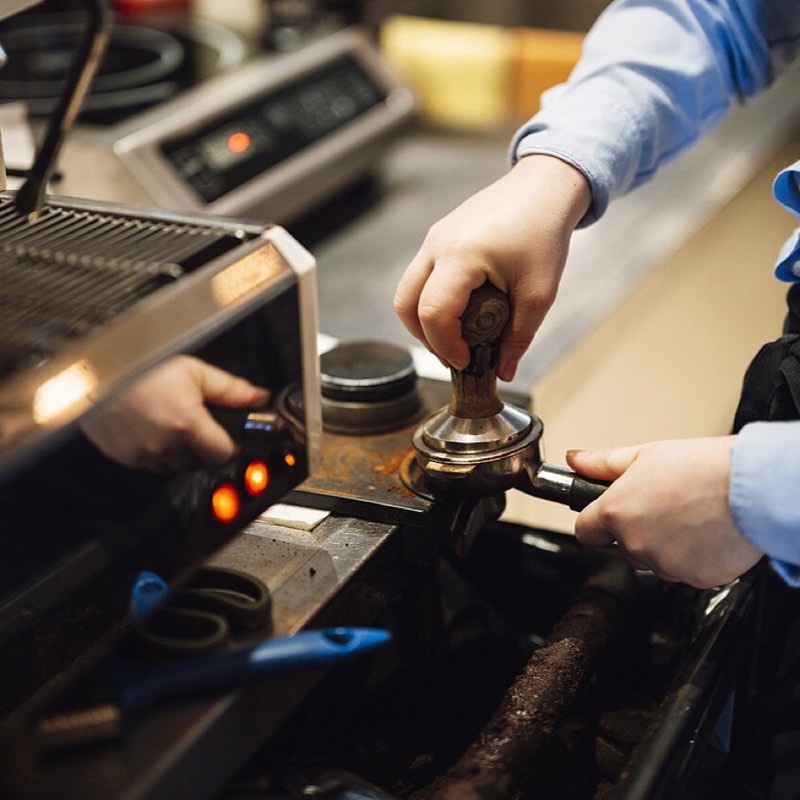
What you need to make espresso at home
- An espresso machine that can reach about 9 bar and hold steady temperature. Manual, semi-automatic and automatic machines all work, but entry-level machines vary a lot.
- A burr grinder with fine adjustment. This matters more than the machine. See grind size chart.
- A scale reading to 0.1 g, with a timer.
- A tamper, portafilter and basket of the right size (usually 18 g).
- Fresh beans roasted for espresso. See espresso roast vs filter roast.
- A knocking box, cloth and cleaning brush.
Capsule and pod machines are simpler but you cannot control grind or dose.
The baseline recipe
| Variable | Starting point |
|---|---|
| Dose (coffee in) | 18 g in an 18 g basket |
| Yield (espresso out) | About 36 g (1:2 ratio) |
| Time | 25–30 seconds from pump start |
| Water temperature | About 92–94 °C |
| Pressure | About 9 bar |
| Grind | Fine, adjusted until time and taste are right |
Use a scale under the cup to weigh the yield, not just the volume. The brew ratio calculator has an espresso preset.
Step-by-step method
1. Warm up the machine for 15–30 minutes, and rinse the portafilter and basket. 2. Weigh your dose. Grind 18 g of beans just before brewing. 3. Distribute the grounds evenly in the basket (tap, or use a distribution tool). 4. Tamp level with firm, even pressure. Consistency matters more than force. 5. Flush the group head briefly, lock in the portafilter and start the shot immediately. 6. Place the cup and scale under the spout and tare the scale. 7. Watch the shot. Liquid should appear after 5–10 seconds and flow like warm honey, then blond near the end. 8. Stop at about 36 g. Check the time. 9. Taste and adjust the grind for the next shot. 10. Clean up. Knock out the puck, rinse the basket and wipe the group head. See also espresso troubleshooting.
Dialling in: fix the shot
Dialling in means adjusting the grind (and sometimes dose) until the shot tastes balanced.
| Shot | Taste | Fix |
|---|---|---|
| Runs fast (under ~22 s), thin crema | Sour, weak, salty | Grind finer |
| Runs slow (over ~32 s), dark or dripping | Bitter, harsh, dry | Grind coarser |
| Channelling (spurts, uneven flow) | Sour and bitter together | Improve distribution and tamp |
| Good time but flat taste | Stale beans or wrong roast | Use fresher beans |
| Good time but too sharp | Under-developed roast | Try a darker roast |
Change grind by one step at a time, and write down the result. Beans change with age and humidity, so you may need to adjust every few days. For Malaysia's humidity, store beans well. See storage tips.
Which beans to use
- Roast level: medium to medium-dark is easiest for espresso. Very light roasts are harder to dial in.
- Blends: many espresso blends combine a sweet base (Brazil, Honduras) with a brighter coffee and sometimes a little Robusta for crema. See best coffee beans for espresso in Malaysia, Brazil and Robusta in espresso blends.
- Freshness: use coffee roasted within about 4 weeks, rested at least 4–7 days. See resting roasted coffee.
If you roast yourself, see roasting levels.
Milk drinks from your espresso
- Flat white: double espresso with silky steamed milk.
- Latte: more milk and a thin layer of foam.
- Cappuccino: equal parts espresso, milk and foam.
- Americano: espresso topped with hot water.
Steam milk to about 55–65 °C, never boil it. Choose a darker, sweeter espresso so the coffee is not lost in milk.
Common mistakes
- Using stale or pre-ground coffee.
- Not weighing the dose or yield.
- Using a blade grinder.
- Changing several variables at once.
- Dirty equipment and old coffee oils.
- Tamping unevenly or tilting the tamper.
- Buying an expensive machine but a cheap grinder.
FAQ: How to make espresso at home
How much coffee do I need for one espresso?
About 18 g for a double shot in a standard basket, yielding around 36 g of espresso.
How long should an espresso shot take?
Roughly 25–30 seconds from the start of the pump.
What grind is best for espresso?
Fine, finer than for pour-over. Adjust one step at a time until time and taste balance.
Why does my espresso taste sour?
Usually under-extraction: the grind is too coarse, the shot is too fast, or the roast is too light. Grind finer.
Why does my espresso taste bitter?
Usually over-extraction: grind too fine, shot too slow or beans over-roasted. Grind coarser.
Can I make espresso without a machine?
You can make a strong, espresso-style coffee with a moka pot or AeroPress, but it is not true espresso. See moka pot guide.
What are the best beans for espresso?
Fresh medium to medium-dark roasted beans, often a blend with a sweet base. See best coffee beans for espresso in Malaysia.
Where can I buy green coffee for espresso roasting?
Scofi supplies unroasted Arabica and Robusta in Malaysia, depending on availability. Contact us.
