Start from a baseline espresso recipe
Troubleshooting works best when you start from a known recipe and change one thing at a time.
| Variable | Starting point |
|---|---|
| Dose | About 18 g in a double basket |
| Yield | About 36 g in the cup (ratio 1:2) |
| Time | About 25–30 seconds |
| Water temperature | About 92–96 °C |
| Pressure | About 9 bar |
| Grind | Adjusted to hit the time |
This matches the starting recipe in our espresso guide. Weigh the dose and the yield on a scale rather than guessing.
Quick diagnosis: sour vs bitter
Sour, sharp, thin or salty espresso is under-extracted: not enough flavour has dissolved. Bitter, harsh, dry or ashy espresso is over-extracted: too much has dissolved, including unpleasant compounds. Taste, then use the table.
| Symptom | Likely cause | First fix |
|---|---|---|
| Sour, sharp, thin, fast shot | Under-extracted: grind too coarse, dose too low, short shot, too cool | Grind finer; check dose and time |
| Bitter, harsh, dry, slow shot | Over-extracted: grind too fine, long shot, too hot | Grind coarser; shorten the yield |
| Weak, watery | Ratio too long or dose too low | Raise dose or shorten the yield |
| Flat, dull | Stale coffee or old, baked roast | Use fresher coffee. See resting roasted coffee |
| Spurting or channelling | Uneven puck | Improve distribution and tamping |
| Thin crema | Stale beans, under-extraction, no Robusta | Check freshness and recipe |
| Burnt, smoky | Roast too dark or machine dirty | Check the roast; clean the machine |
Channelling: when water finds the easy path
Channelling happens when water runs through weak spots in the coffee puck instead of passing evenly. Signs include spurting streams, pale patches on the puck, a fast flow and a shot that tastes both sour and bitter. Fixes:
- Distribute evenly before tamping, with a distribution tool or tapping.
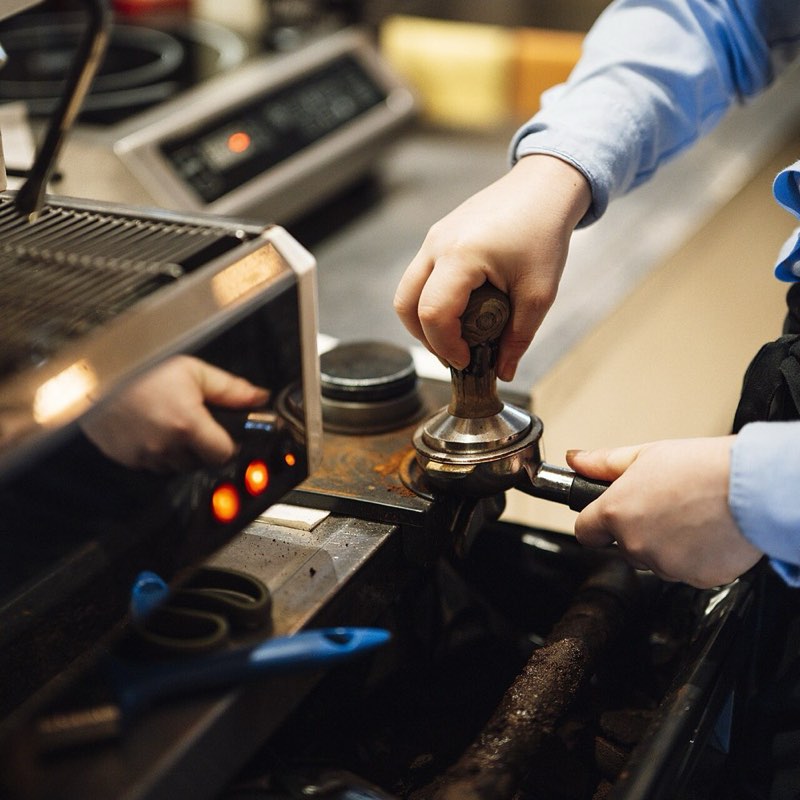
- Tamp level with steady pressure.
- Use an even grind with a sharp, well-calibrated grinder.
- Avoid over-dosing the basket.
- Check the basket and group head for damage or build-up.
Clean machines matter: backflush and clean the group head regularly according to the manufacturer’s instructions.
Is it the coffee, the grinder or the machine?
- Coffee: very fresh coffee (a day or two out of the roaster) degasses and gives uneven shots, while very old coffee tastes flat. Most roasters suggest resting espresso several days. Some blends and light roasts need a finer grind and a longer shot. See espresso roast vs filter roast.
- Grinder: burr wear, retention and consistency matter more than price. Re-dial after each new coffee.
- Machine: temperature, pressure and cleanliness affect results. Have it serviced regularly.
- Water: hard or poor-quality water causes scale and flavour problems.
A simple dial-in routine
- 1. Check freshness and dose accurately.
- 2. Pull a shot at the baseline recipe and note the time and taste.
- 3. Taste: sour or bitter?
- 4. Change one variable, usually the grind, then pull again.
- 5. Adjust the yield only if the grind alone cannot fix the balance.
- 6. Record the recipe (dose, yield, time, temperature, grind) and the date of roasting.
- 7. Re-check during the day, because weather and humidity change extraction in warm climates. See roasting in Malaysia’s heat and humidity.
Troubleshooting milk drinks
Espresso that tastes slightly sharp black can taste fine in milk, but bitter or flat shots do not improve. Test shots straight and in the milk drink you sell most. Milk-heavy menus often work well with a medium to medium-dark blend and a little Robusta for body. See Robusta in espresso blends and house blend guide.
When the problem is the roast or the beans
If you cannot fix the shot, the coffee may be the issue: baked, scorched or underdeveloped roasts taste wrong at any grind, and defective green coffee shows up in the cup. See roast defects 101, defect detection and moisture levels. Roasters can source graded green coffee from Scofi in Butterworth, Penang, depending on availability: see buy green coffee beans online.
FAQ: Espresso troubleshooting
Why does my espresso taste sour?
Usually under-extraction: the shot ran too fast, the grind is too coarse or the dose is too low. Grind finer.
Why does my espresso taste bitter?
Usually over-extraction: the shot ran too slow or too long. Grind coarser or shorten the yield.
What is channelling?
Water running unevenly through weak spots in the puck, causing uneven, sour-and-bitter shots.
How long should an espresso shot take?
Typically about 25–30 seconds for a 1:2 recipe, though recipes vary.
Why is my crema thin?
Often stale beans, under-extraction or a blend without Robusta.
How often should I change the grind?
Whenever the shot time or taste drifts, and with every new coffee.
Does the roast date matter?
Yes. Very fresh coffee is gassy and very old coffee is flat; many roasters rest espresso several days.
Where can I get consistent beans for espresso?
Scofi supplies green coffee to roasters; contact us at our contact page.
