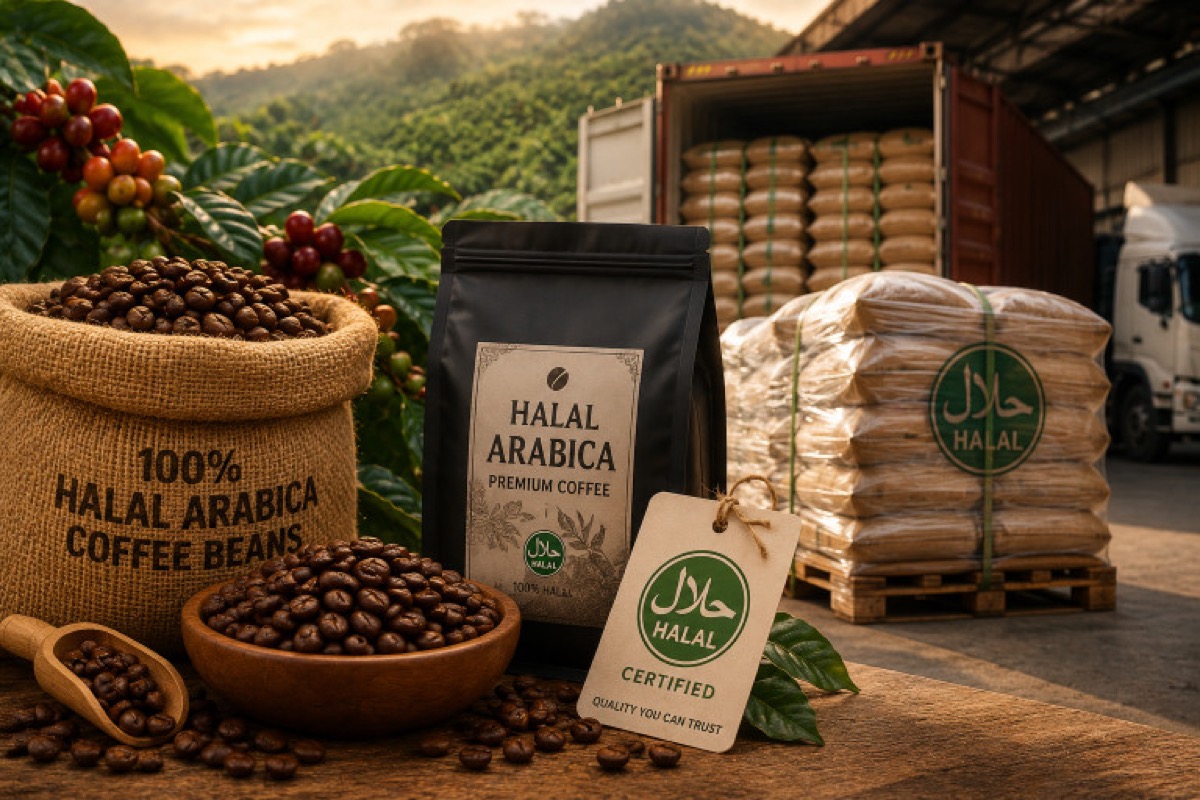
Why Halal Arabica supply matters in Malaysia
This guide explains why Halal certification matters, how Arabica beans fit Muslim consumer expectations, and why Malaysia buyers often prefer suppliers who understand traceability, clean handling, and documentation.
Malaysia has a strong Halal ecosystem and a large Muslim consumer base. For coffee businesses, this creates an important buyer requirement: the product must not only taste good, but also be trusted. A café serving Muslim consumers, a hotel managing procurement, or a roastery supplying retail packs may need to explain whether the coffee, ingredients, packaging, and handling process are aligned with halal expectations.
Green Arabica coffee beans are generally simple agricultural products, but the supply chain can still raise buyer questions. Are the beans mixed with flavouring? Were they processed or stored near non-halal ingredients? Is the final roasted product plain coffee, or does it contain additives such as alcohol-based flavouring, dairy ingredients, or non-certified components? These questions matter more when the coffee is sold as a finished consumer product.
For green coffee sourcing, the most practical approach is to work with suppliers who understand documentation, clean storage, packaging integrity, and traceability. A halal-aware supplier does not only “sell beans”; the supplier helps buyers reduce uncertainty and communicate more confidently to their customers.
- For cafés: Halal trust helps Muslim customers feel comfortable ordering espresso, filter, iced coffee, and milk-based drinks.
- For roasters: Clear sourcing and handling records support retail packaging, B2B supply, and customer confidence.
- For hotels: Procurement teams often prefer suppliers who can explain ingredients, packaging, storage, and traceability clearly.
Halal certification importance for coffee buyers
Halal certification gives buyers a stronger layer of assurance because it is based on documented standards, audits, and controlled handling practices. For plain green coffee beans, the risk profile is usually different from complex food products. However, certification becomes more important when coffee is roasted, flavoured, blended with additives, packed as a retail product, served with milk or syrup, or used in hospitality and foodservice programmes.
In business terms, Halal certification helps reduce doubt. It supports procurement approval, brand trust, supermarket listing, hospitality compliance, and customer confidence. For Muslim consumers, the Halal logo is more than a label—it signals that the product has been reviewed under a recognizable framework.
When Halal documentation becomes especially important
- Retail roasted coffee packs: customers may look for Halal claims, ingredients, and traceability.
- Flavoured coffee: syrups, flavourings, and extracts may require stronger review.
- Instant or 3-in-1 coffee: dairy, emulsifiers, sweeteners, and additives increase documentation needs.
- Hotel and corporate procurement: buyers often require supplier records for internal approval.
- Export-oriented products: Halal documentation can support market access and buyer confidence.
- Certification clarity: Ask whether certification applies to the green bean, roasted product, facility, or final packaged item.
- Ingredient control: Plain coffee is different from flavoured or mixed products with added ingredients.
- Procurement trust: Hotels, retailers, and corporate buyers often prefer stronger documentation.
Arabica beans for Muslim consumers
Arabica coffee is valued for its smoothness, aroma, and wide flavour range. For Muslim consumers, the key question is usually not whether Arabica itself is acceptable, but whether the supply chain and final product are trustworthy. Plain coffee beans are agricultural commodities, but finished coffee drinks can include other components: milk, creamers, syrups, toppings, flavourings, and additives.
This is why cafés and roasters should separate two levels of assurance. First, the green bean supply: origin, handling, storage, and packaging. Second, the finished product: roasting, flavouring, blending, packaging, and drink preparation. A halal-aware operation considers both levels.
What Muslim consumers may care about
- Clear ingredients: plain coffee vs flavoured coffee vs mixed beverage.
- Trustworthy handling: storage and preparation away from questionable ingredients.
- Recognizable certification: especially for packaged or flavoured products.
- Brand transparency: honest explanation without overclaiming.
- Consistent quality: halal confidence plus good taste and freshness.
| Product Type | Typical Buyer Question | Halal-Aware Response | Related Buyer Action |
|---|---|---|---|
| Green Arabica beans | Where are the beans from and how are they stored? | Provide origin, handling, packaging, and QC information. | Request specs and storage details. |
| Roasted coffee beans | Is the roasting/packing process controlled? | Check facility practices and product documentation. | Confirm final product scope. |
| Flavoured coffee | Are the flavourings halal-compliant? | Verify additive sources and certification. | Request ingredient documentation. |
| Café drinks | What milk, syrup, or toppings are used? | Control drink ingredients and preparation flow. | Train staff and label clearly. |
Why Malaysia buyers trust halal-aware supply
Malaysia buyers trust halal-aware supply because it reduces business risk. When procurement teams, café owners, and distributors can answer customer questions clearly, they protect their reputation. This is especially important in Muslim-majority markets where consumers may expect Halal sensitivity even for products that seem simple.
Trust also comes from consistency. A supplier who can provide the same documentation style, the same QC discipline, and the same communication process across different lots becomes easier to work with. That is why buyers should evaluate not only “is this coffee good?” but also “can this supplier support my business responsibly over time?”
Trust factors Malaysia buyers often look for
- Clear product scope: green bean, roasted bean, flavoured coffee, or final beverage.
- Traceability: origin, process, packaging, and supplier information.
- Clean storage: protection from odour, humidity, pests, and cross-contamination concerns.
- QC documentation: moisture, defects, cupping notes, and retention sample practices.
- Responsive communication: quick explanation when buyers need answers for customers or procurement teams.
- Traceability: Know the origin, process, lot identity, and packaging pathway before buying.
- Storage confidence: Stable storage protects quality and strengthens buyer trust in Malaysia’s humid climate.
- Supplier reliability: Good suppliers support documents, samples, and practical answers—not only pricing.
How Scofi supports halal-aware Arabica buyers
Scofi supports Malaysian buyers by focusing on practical supply confidence: clear communication, green coffee quality checks, Malaysia-local coordination where available, and menu-fit recommendations. For Halal-related requirements, we encourage buyers to clarify the exact product scope and documentation needed before purchase, especially when the coffee will be roasted, flavoured, packed, served in hotels, or sold as retail products.
Why Scofi is a competitive partner
- Malaysia-local coordination: faster sampling and domestic delivery/pickup where stock is available.
- Quality-first approach: moisture guidance, defect awareness, cupping-based evaluation, and retention sample mindset.
- Buyer education: guides that help cafés, roasters, and hotels ask the right sourcing questions.
- Menu-fit shortlists: Arabica options for house espresso, filter, iced signatures, and hospitality programmes.
- Clear documentation discussion: support for buyers who need to understand product scope, packaging, and supply details.
To build a stronger sourcing workflow, read Buying Checklist, Quality Control, and Scofi Malaysia Supplier.
Halal-Aware Arabica buyer checklist
Use this checklist when buying Arabica for Muslim consumer markets, hotel procurement, or retail packaging. It is not a replacement for formal certification review, but it helps buyers prepare the right questions before sourcing.
| Checklist Item | Question to Ask | Why It Matters |
|---|---|---|
| Product scope | Is this green coffee, roasted coffee, flavoured coffee, or final beverage? | Different products may require different documentation. |
| Ingredients | Are there additives, flavourings, milk powders, or syrups? | Added ingredients increase Halal review needs. |
| Certification | Is certification available, and what exactly does it cover? | Avoid assuming certification applies to every product stage. |
| Storage | How are beans stored and protected? | Clean storage protects both quality and trust. |
| Traceability | Can the supplier explain origin, process, packaging, and lot identity? | Traceability supports confidence and procurement approval. |
| QC | Are moisture, defects, and cupping notes available? | Quality assurance supports repeatable supply. |
FAQ: Halal Arabica Supply
Is Arabica coffee halal?
Plain Arabica coffee beans are agricultural products, but buyers should still verify handling, storage, and whether any flavourings or additives are used in the final product.
Why does Halal certification matter for coffee?
Certification helps reduce doubt, supports procurement approval, and gives Muslim consumers greater confidence—especially for roasted, flavoured, packed, or ready-to-drink products.
Does green coffee need the same Halal documentation as flavoured coffee?
Not always. Green coffee, roasted coffee, flavoured coffee, and mixed beverages have different risk profiles. Always confirm the exact product scope.
What should cafés check for halal-aware coffee service?
Check coffee source, milk, syrups, toppings, flavourings, storage, preparation flow, and whether any certification or documentation is needed for your business model.
Why do Malaysia buyers trust halal-aware suppliers?
They trust suppliers who provide clarity, traceability, clean handling, stable storage, and clear communication when procurement or customers ask questions.
Can Halal certification help hotels and corporate buyers?
Yes. Hotels and corporate procurement teams often prefer stronger documentation because it supports internal approval and guest confidence.
What is the difference between halal-aware supply and certified halal product?
Halal-aware supply means the supplier understands halal-related buyer concerns. Certified halal means a recognised certification applies to a specific product or process scope.
What documents should buyers request?
Depending on product scope: origin/spec sheet, ingredient list, certification documents if available, packaging details, and supplier quality records.
Does Scofi help buyers understand halal-related requirements?
Scofi can help buyers clarify product scope, sourcing details, packaging, QC information, and what documentation should be discussed before purchase.
Can Scofi recommend Arabica for Muslim consumer-focused cafés?
Yes. Share your menu, target consumers, volume, and documentation needs. Scofi can propose suitable Arabica lots and support Malaysia-local sampling where available.
