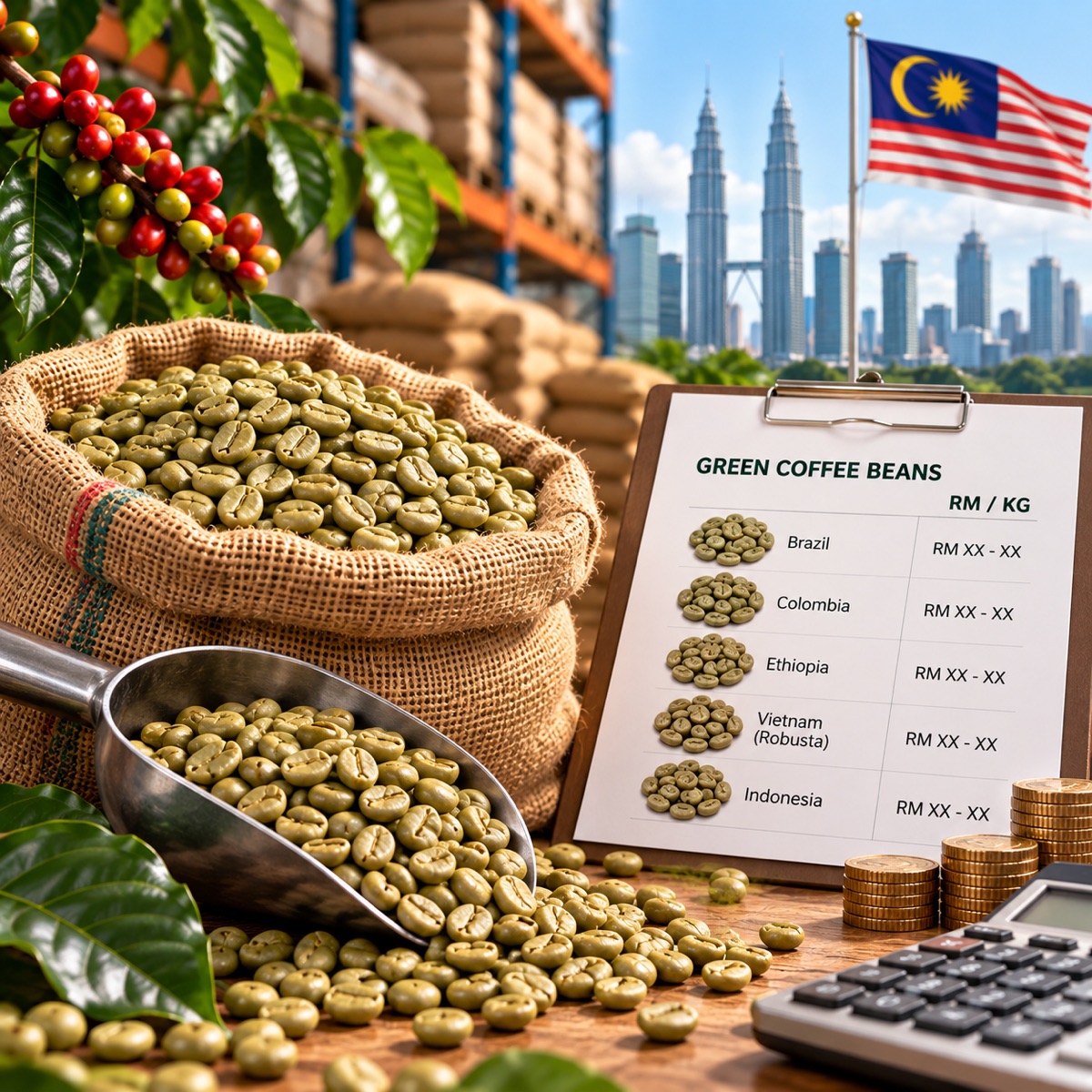
Why no single price applies
Green coffee is traded like a commodity, and what you pay depends on what exactly you are buying and how you buy it. A commercial Robusta for kopi and a high-scoring washed Arabica are different products with very different prices. Any fixed number on a web page would soon be out of date, so this guide shows what moves the price and how to judge a quote. For a current figure for your specification, request a written quotation. See also Arabica prices and Indonesia Robusta price in Malaysia.
What decides the price per kg
| Driver | How it affects price |
|---|---|
| Species | Arabica generally costs more than Robusta. See Arabica vs Robusta |
| Origin and process | Specialty origins and careful processing cost more. See processing methods |
| Grade and defects | Cleaner lots cost more. See grading standards |
| Cup score and traceability | Higher scores and lot-level traceability carry premiums |
| Order size | Larger volumes usually lower the per-kilogram price |
| Packaging | Barrier liners and vacuum packs add cost. See packaging options |
| Market and currency | Futures, harvest timing and exchange rates move the baseline |
Delivery location and payment terms also change the final cost.
Arabica and Robusta price ranges: how to think about them
Rather than quoting figures that change, think in tiers:
- Commercial Robusta: the lowest-cost tier, widely used in traditional coffee and manufacturing. See Robusta for Malaysian coffee shops.
- Clean, graded Robusta: a step up for better consistency and less sorting loss.
- Commercial Arabica: chocolate-nut bases such as Brazil for espresso and milk drinks.
- Specialty Arabica: higher-scoring washed, natural and honey lots with traceability.
- Rare and competition lots: the highest prices. See rare varieties and Geisha.
The right tier depends on your product, margins and customers, not on getting the lowest number.
From green price to roasted cost
Roasting drives off water, so you sell less roasted coffee than the green coffee you bought. Typical weight loss is about 12–20%. To get the green cost behind each roasted kilogram, divide the green price by the roasted yield.
| Weight lost in roasting | Roasted yield | Cost factor |
|---|---|---|
| 12% | 88% | ×1.14 |
| 15% | 85% | ×1.18 |
| 18% | 82% | ×1.22 |
| 20% | 80% | ×1.25 |
Example (illustrative only, not a Scofi price): if green coffee costs 100 units per kg and you lose 15% in roasting, the green cost of one roasted kilogram is about 118 units (100 ÷ 0.85), before labour, utilities and packaging. Use your own roast loss from your roast logs. See development time ratio and roasting levels, because darker roasts lose more weight.
Compare quotes by cost per usable kilogram
- Check what is included: ex-warehouse, delivered, or import cost.
- Allow for sorting loss and defects.
- Check moisture: wetter beans lose more weight and age faster. See moisture levels.
- Count consistency: unstable roast or flavour causes waste.
- Look at payment terms and delivery timing.
Ways to manage cost without hurting quality
- Blend sensibly: a measured Robusta share in milk-heavy blends can balance cost. See pre-roast vs post-roast blending.
- Buy to your turnover: avoid holding stock for months. See storage tips.
- Split purchases over the year rather than buying everything at one price.
- Keep an approved reference sample so you can switch suppliers confidently.
- Choose the right tier for each menu role, not the cheapest for everything.
How to request a price quotation
- Intended use (espresso, filter, kopi, premix).
- Species, origin and process preferences.
- Grade or maximum defect level, moisture range and bean size.
- Monthly and total volume.
- Packaging and net weight per bag.
- Delivery location and timing.
Send these by WhatsApp or the contact page, and see the buying checklist and how to buy.
FAQ: Green coffee beans price in Malaysia
How much is green coffee per kg in Malaysia?
It varies by species, origin, grade, volume and market. Request a quotation for your specification.
Why is Arabica more expensive than Robusta?
Higher-altitude farming, lower yields and more labour. See Arabica vs Robusta.
Does buying in bulk lower the price?
Usually, larger volumes reduce the per-kilogram price, though storage and cash flow matter.
How much weight is lost when roasting?
Typically about 12–20%, mostly water.
How do I calculate cost per roasted kilogram?
Divide the green price per kg by the roasted yield, for example by 0.85 for 15% loss.
Does packaging change the price?
Yes. Liners and vacuum packs add cost but protect quality. See packaging options.
Why do quotes differ between suppliers?
Different grades, origins, packaging, delivery terms and market timing.
How do I get a quote from Scofi?
Contact us with your use, volume and delivery location.
